As I have a small currently 5.5 years old Kid Dimitar at home and i'm doing my best to make him learn new things and advance in different areas of life and knowledge.
Today Decided to introduce him to Linux4Kids gcompris a KDE educational set of games for small children.
Once installed with simple
# apt install gcompris-qt
It works fine and default version installable from default Debian distribution is fine, except it does not support Bulgarian.
That is again not a nice suprise, as even some pseudo languages like Belarusian are there to set but Bulgarian missing on the default installable pack:
# dpkg -l |grep -i gcompris
ii gcompris-qt 3.1-2 amd64 educational games for small children
ii gcompris-qt-data 3.1-2 all data files for gcompris-qt
After some tampering and unable to find a native .deb port of the latest release and my undesire to move from debian 12 (bookworm) Desktop Linux laptop at the moment to Debian 13 Trixie, i've finally found a way to install it via flatpak:
For those who never used snap package ecosystem or flatpak, here is a shortly synthesis on it:
Flatpak is an open-source, next-generation framework for building, distributing, and running sandboxed desktop applications on Linux.
It enables developers to package apps once and run them on any Linux distribution by including all necessary dependencies.
Flatpak improves security by isolating applications from the host system.
Flatpaks are containerized applications. They require more space because the bring along their own versions of their dependencies instead of relying on system versions.
While a single application will have greater space requirements, the base images [and potentially overlays] will get shared between them and each successive flatpak will potentially require less overhead.
The pros to using them is that flatpaks are often more current than their distribution packaged versions and they are somewhat isolated from the base system. The cons are that they're not managed with the rest of your system packages, can have slower start times, occasionally have permissions issues, and take up more space.
In some cases, flatpak is a better choice. Sometimes, it's not, and there's no way we can really determine that for you.
Tried up to my best to install the newest version of gcompris which as of time of writting this blog post is gcompris 25.1
# apt info flatpak|grep -i 'descr' -A8 -B8
WARNING: apt does not have a stable CLI interface. Use with caution in scripts.
Recommends: ca-certificates, default-dbus-system-bus | dbus-system-bus, desktop-file-utils, hicolor-icon-theme, gtk-update-icon-cache, libpam-systemd, p11-kit, polkitd | policykit-1, shared-mime-info, xdg-desktop-portal (>= 1.6), xdg-desktop-portal-gtk (>= 1.6) | xdg-desktop-portal-backend, xdg-user-dirs
Suggests: avahi-daemon, malcontent-gui
Conflicts: xdg-app
Replaces: xdg-app
Homepage: https://flatpak.org/
Download-Size: 1,400 kB
APT-Manual-Installed: yes
APT-Sources: http://ftp.debian.org/debian bookworm/main amd64 Packages Description: Application deployment framework for desktop apps
Flatpak installs, manages and runs sandboxed desktop application bundles.
Application bundles run partially isolated from the wider system, using
containerization techniques such as namespaces to prevent direct access
to system resources. Resources from outside the sandbox can be accessed
via "portal" services, which are responsible for access control; for
example, the Documents portal displays an "Open" dialog outside the
sandbox, then allows the application to access only the selected file.
# env PULSE_LATENCY_MSEC=60 ; flatpak run org.kde.gcompris
If still sound glithches are present a workaround is to tune PipeWire buffer/quantum size:
PipeWire buffer/quantum size too aggressive?
Many crackling issues come from too small quantum. Create ~/.config/pipewire/pipewire.conf.d/99-custom.conf
# vim ~/.config/pipewire/pipewire.conf.d/99-custom.conf
and add:textcontext.properties = {
default.clock.rate = 48000
default.clock.quantum = 1024
default.clock.min-quantum = 512
default.clock.max-quantum = 2048
}
#systemctl –user restart pipewire pipewire-pulse
Create a new wrapper script to run you gcompris easily
# vim /usr/local/bin/gcompris.sh
#!/bin/bash
# little hack script to make music streamed via pulseaudio to not have severe glitches when running gcompris latest release on debian 12
# through flatpak
# if not working run cmd
# systemctl –user restart pipewire
LANG=bg_BG.UTF-8
SDL_AUDIODRIVER=pulseaudio
#flatpak run –device=all –socket=pulseaudio org.kde.gcompris
flatpak override –user –env=SDL_AUDIODRIVER=pulseaudio org.kde.gcompris
flatpak override –user –filesystem=~/.config/pipewire:ro org.kde.gcompris
LANG=bg_BG.UTF-8 flatpak run –socket=pulseaudio org.kde.gcompris
# chmod +x /usr/local/bin/gcompris.sh
Hence I run the wrapper script and let the kid enjoy the nice educational stuff while I enjoyed the nice kiddish peaceful music !
AI is more and more entering the Computer scene and so is also in the realm of Computer / Network management. Many proficient admins already start to get advantage to it. AI doesn’t need a GUI, or a special cloud dashboard or fancy IDE so for console geeks Sysadmins / System engineers and Dev Ops it can be straightly integrated into the bash / zsh etc. and used to easify a bit your daily sys admin tasks.
If you live in the terminal, the most powerful place to add AI is Bash itself. With a few tools and a couple of lines of shell code, you can turn your terminal into an AI-powered assistant that writes commands, explains errors, and helps automate everyday Linux tasks.
No magic. No bloat. Just Unix philosophy with a brain.
1. AI as a Command-Line Tool
Instead of treating AI like a chatbot, treat it like any other CLI utility:
stdin → prompt
stdout → response
pipes → integration
Hardware Requirements of Ollama Server
2. Minimum VM (It runs, but you’ll hate it)
Only use this to test that things work.
vCPU: 2
RAM: 4 GB
Disk: 20 GB (SSD mandatory)
Storage type: ( HDD / network storage = bad )
Models: phi3, tinyllama
Expect:
Very slow pulls
Long startup times
Laggy responses
a. Recommended VM (Actually usable)
This is the sweet spot for Bash integration and daily CLI use.
vCPU: 4–6 (modern host CPU)
RAM: 8–12 GB
Disk: 30–50 GB local SSD
CPU type: host-passthrough (important!)
NUMA: off (for small VMs)
Models that feel okay:
phi3
mistral
llama3:8b (slow but tolerable)
b. “Feels Good” VM (CPU-only but not painful)
If you want it to feel responsive.
vCPU: 8
RAM: 16 GB
Disk: NVMe-backed storage
CPU flags: AVX2 enabled
Hugepages: optional but nice
Models:
llama3:8b
codellama:7b
mixtral (slow, but usable)
Hypervisor-Specific Advice (Important)
c. KVM / Proxmox (Best choice)
CPU type: host
Enable AES-NI, AVX, AVX2
Use virtio-scsi
Cache: writeback
IO thread: enabled
d. If running VM on VMware platform
Enable Expose hardware-assisted virtualization
Use paravirtual SCSI
Reserve memory if possible
e. VirtualBox (Not recommended)
Poor CPU feature exposure
Weak IO performance
Avoid if you can
f. Local AI With Ollama (Recommended)
If you want privacy, low latency, and no API keys, Ollama is currently the easiest way to run LLMs locally on Linux.
3. Install Ollama
# curl -fsSL https://ollama.com/install.sh | sh
Start the service:
# ollama serve
Pull a model (lightweight and fast):
# ollama pull llama3
Test it:
ollama run llama3 "Explain what the ls command does"
If that works, you’re ready to integrate.
To check whether all is properly setup after installed llama3:
root@haproxy2:~# ollama list
NAME ID SIZE MODIFIED
llama3:latest 365c0bd3c000 4.7 GB About an hour ago
root@haproxy2:~# systemctl status ollama
● ollama.service – Ollama Service
Loaded: loaded (/etc/systemd/system/ollama.service; enabled; preset: enabled)
Active: active (running) since Mon 2026-01-12 16:43:30 EET; 15min ago
Main PID: 37436 (ollama)
Tasks: 16 (limit: 6999)
Memory: 5.0G
CPU: 13min 5.264s
CGroup: /system.slice/ollama.service
├─37436 /usr/local/bin/ollama serve
└─37472 /usr/local/bin/ollama runner –model /usr/share/ollama/.ollama/models/blobs/sha256-6a0746a1ec1aef3e7ec53>
If you prefer cloud models (OpenAI, Anthropic, etc.), the pattern is identical:
Use curl
Pass prompt
Parse output
Once AI returns text to stdout, Bash doesn’t care where it came from.
12. Best Practices how to use shell AI to not overload machine
Before you go wild:
Don’t auto-execute AI output
Don’t run AI as root
Treat responses as suggestions
Version-control important scripts
Keep prompts specific
AI is powerful — but Linux still assumes you know what you’re doing.
Sum it up
Adding AI to Bash isn’t about replacing skills.
It’s about removing friction.
When AI gets easy to use from the command line it is a great convenience for those who don't want to switch to browser all the time and copy / paste like crazy. AI as a command-line tool fits perfectly into the Linux console:
composable
scriptable
optional
powerful
Once you’ve used AI from inside your shell for a few hours, going back to browser-based AI chat stuff like querying ChatGPT feels… slow and inefficient.
However keep in mind that ollama is away from perfect and has a lot of downsides and ChatGPT / Grok / DeepSeek often might give you better results, however as ollama is really isolated and non-depend on external sources your private quries will not get into a public AI historic database and you won't be tracked.
So everything has its Pros and Cons. I'm pretty sure that this tool and free AI tools like those will certainly have a good future and will be heavily used by system admins and
programmers in the coming future.
The terminal just got smarter. And it didn’t need a GUI to do it.
In 2025, we live in a world where almost every service – from email and calendar to file storage and even our journals – is run by someone else, stored on someone else’s servers, governed by someone else’s terms of service. Big Tech has normalized it. Most users don't even ask where their data lives.
But among all this convenience and delegation, a quiet movement continues, the so calledself-hosting.
Running your own services, on your own hardware, under your control.
Some call it old-school and waste of time. Others call it paranoid and mania. But if you ask those of us who've tried it, there’s something deeply normal in human sense about owning your digital home.
Something that inspires and gives you energy to be against the flow, feels good.
But anyways,
Why Bother Self-Hosting?
1. You Own Your Data
It’s not locked in a black-box “cloud” with no export button. When you run your own email server, Nextcloud, or RSS reader, the data lives on your disk, not theirs.
2. You Learn More About "the Stack" and get better insight on software
Spinning up a VPS and running a full LAMP/LEMP stack teaches you more than any AWS console ever will. You learn:
How DNS, SMTP, TLS actually work
Systemd, firewalls, fail2ban
Troubleshooting logs, performance, backups
You’re not clicking buttons—you’re building.
3. Privacy by Design embedded
Even with GDPR and privacy policies, hosted services scan your data, log metadata, and track usage. With self-hosted services, your metadata isn’t leaked. There’s no hidden analytics tracking when you log into your calendar.
4. Resilience & Independence in the more and more dependent world
When a cloud service goes down (remember Gmail outages? GitHub DDoS attacks?), your digital life halts.
Self-hosters can:
Access data even when offline
Control redundancy and backups
Choose their own update cycles
5. It’s a Form of Digital Homesteading
You can think of the cloud as the urban city- efficient, busy, and surveilled. Self-hosting is the countryside. It’s quieter, harder, but it's yours.
“A home server is not just a computer. It’s a statement: I choose to build, not just consume.”
What Can You Realistically Self-Host in 2025?
Thanks to maturing open source projects, you can run nearly everything yourself with minimal resources. Below some examples:
Let’s be honest: self-hosting adds responsibility. You become the sysadmin. That means:
Keeping software up to date
Setting up TLS with Let’s Encrypt
Hardening SSH, using fail2ban
Setting up backups—ideally offsite
But that’s not a burden—it’s a privilege. When you’re in control, you get to choose how secure, private, and robust your system is.
You’re not trusting a SaaS company’s security—you become the security.
Well of course the down side of it is things, can often become so complex and big that you cannot manage it yourself and you have to find a sysadmin buddy to help you maintain your thing
or even hire someone to help you.
A Philosophical Note: Against Digital Apathy that rules sysadmin minds
Most people have accepted a world where they can’t even host their own blog without five different cloud accounts. But it wasn’t always like this. The early internet was filled with homepages, shell accounts, FTP servers, personal IRC bots.
In that spirit, self-hosting is not just about tech—it’s about reclaiming agency.
It’s a quiet rebellion. A return to DIY computing. A form of digital asceticism that resists the consumerist mindset of “pay someone else to do everything.”
Like growing your own food, even if it’s harder, it makes you more alive.
How to Start Today
If you’re curious about self-hosting, here’s a no-fear path:
Start small – Host a local file server or wiki.
Use Docker – Tools like Portainer or Yacht simplify managing containers.
Use a domain – Get a .net or .org domain and point it to your IP.
Set up a reverse proxy – Like Nginx or Traefik, for managing HTTPS and access.
Don’t host what you don’t understand – Learn before you expose things to the internet.
Final Words
In 2025, it’s easy to feel like everything is owned, managed, and decided by corporations. But it doesn’t have to be.
Self-hosting isn’t dead—it’s rising quietly. In homelabs, in student dorms, in off-grid locations. It’s how many of us reclaim computing not just as a tool, but as a craft. Something we shape. Something we own.
Short Biography of Saint Acacius Serski (of Asvestochori, Thessaloniki)
He was born with the name Atanas in 1792 in the Bulgarian village of Novo Selo near Thessaloniki.
When he was nine years old, his family moved with him to the town of Syar,[1] where he was taken as a foster child by the local bey as an infant and became a Muslim.
His parents, embittered, returned and settled in Thessaloniki.[5] Slandered by his stepmother for wanting to rape her, Atanas was expelled by the bey at the age of 18 and went to live with his parents.
Realizing the sin of his apostasy, he repented and was tonsured a monk at the Hilendar Monastery on Mount Athos, where he was accepted back into the bosom of the church.
After a year, he withdrew to the Iveron Monastery, where the monks Euthymius and Ignatius had recently suffered. Upon learning of their martyrdom, Akakiy decided to follow their example and publicly declare his renunciation of Islam, even though he knew that he would be sentenced to death for it.
On April 1, he departed by ship from Mount Athos and arrived in Galata, a district of the capital Constantinople, on April 23. On April 29, Saturday, Akakiy appeared before the Turkish court, recounted his renunciation, and publicly cursed Muhammad, calling him a false prophet.
The Ottomans began to try to persuade him to remain in Islam with exhortations and torture, but Akakiy refused and was condemned. On May 1, 1816, he was beheaded at the place of his forehead called Parmak Kapi.[10] His body was bought for 800 groschen and taken to Mount Athos.
His holy relics were placed first in his cell, and then in the newly built church in honor of the martyrs Euthymius and Ignatius who had suffered before him. The head of Saint Akakiy is today in the Russian Athos monastery "Saint Panteleimon".
The Bulgarian saint Akakiy of Sersky is commemorated on Mount Athos on the day of his martyrdom, May 1, together with the martyrs Euthymius (March 21) and Ignatius (October 8), for which a common service of the three saints was composed.
Sant Acacius is not to be mistaken with Sant Acacious of Byzantium. Saint Acacius (Greek: Ἅγιος Ἀκάκιος; died 303), also known as Agathius of Byzantium, Achatius, or Agathonas to Christian tradition, was a Cappadocian Greek centurion of the imperial army, martyred around 304.)
Life of the Holy Martyr Akakiy (Syarsky) according to Living of Saints
The Holy Martyr Akakiy (Acacius), in holy baptism Athanasius, was born in the Bulgarian village of Novo Selo (Greek: Neochori) nowadays Asvestochori, Thessaloniki near the city of Thessaloniki.
Due to poverty, his parents moved to the city of Serres.
When he was nine years old, they send him to learn the trade from a shoemaker.
But the shoemaker beat the boy so severely every day that once, on Good Friday, he could not stand it and ran away in tears into the street.
Unfortunately, two Turkish women met him, flattered him, took him into their home, fed him, and so bewitched him with their beautiful words that they convinced him to renounce Christ.
Then the city bey (local area governor) took him to himself, performed the rite of Mohammedan circumcision over him, adopted him, and loved him and his wife as his own son.
After Athanasius had lived in the Bey's house for nine years and had already grown to manhood, the Bey's mistress changed her love for him from maternal to carnal and – like Potiphar's wife – tried to entice him into sin.
The chaste youth – like the wonderful biblical Joseph – fled from her, but she, embittered, slandered him through her husband that he allegedly wanted to defile herself with her.
Believing his wife false accusations, the Bey expelled him from his home and granted him complete freedom to go wherever he wanted.
He went to his parents, who after his renunciation returned to Thessaloniki. They were very happy about his return and especially about his desire to return to the Church of Christ.
But his wise mother warned him that he who voluntarily renounced Christ must wash away the sin of his renunciation with his own blood. He took his mother's advice deeply to heart, withdrew to the Hilendar Monastery on Mount Athos, confessed to the priest of the Xenophon Skete, and was restored to Christianity through chrism. Hearing of the exploits of the recently martyred Athonite holy martyrs Euthymius and Ignatius, he went to their former mentor, Hieromonk Nicephorus, with a request to prepare him for martyrdom. The priest explained to Athanasius all the difficulty of this feat, but he agreed to take him under his guidance.
After a little hesitation, Athanasius quickly advanced in the spiritual life – he labored with love, and his eyes, from heartfelt tenderness, became springs of incessant tears.
Seeing his perfection in virtue and steadfastness in thought, the clergyman tonsured him into monasticism with the name Akakiy ( Acacius ) and after some time blessed him to set out on a martyr's journey, for which he gave him as a companion the same elder Gregory, who at one time accompanied the venerable martyrs Euthymius and Ignatius.
Soon after that, they left the Holy Mountain and went to Constantinople.
On the day of the journey itself, Akakiy partook of the Holy Mysteries of Christ, dressed as a Turk and, shedding tears, accepted the last blessing of the venerable Gregory for martyrdom.
Having arrived at the High Ottoman Gate, he threw off his green turban from his (a sign for belonging to Islamic faith) head and began to trample it with his feet, confessed Christ and cursed Muhammad.
Having failed to persuade him to remain a Mohammedan with exhortations, the judges ordered him to be beaten and thrown into prison.
The next day, Akakiy was brought before the vizier himself, but this also proved to be useless, which is why the sentence of beheading followed.
On the eve of the execution of the sentence, the holy martyr communed with the Holy Mysteries.
On May 1, 1816, the Turks beheaded the holy martyr Akakiy in a place called Parmak-kapi.
With money collected by Christians, the monk Gregory bought the body of the holy martyr from the soldiers-guards and took it to Mount Athos.
His holy relics were first placed in his cell, and then he was buried in the newly built church in honor of the holy martyrs Euthymius and Ignatius, who had suffered before him. The head of Saint Akakiy is now in the Russian Athonite monastery “St. Panteleimon” on Holy Mount Athos.
On the day of his martyrdom, his memory on Mount Athos is honored together with that of the venerable martyrs Euthymius (March 21) and Ignatius (October 8), because a common service has been composed for the three saints, and there is no separate service for St. Acacius.
A sensational legend, prooved by modern Theologist to be a fact is the famous Great Martyr Barbara (Varvara as known in Slavonic realm) is of Bulgarian origin and her martyrdom has occured in country territory of contemporary Bulgaria.
Saint Barbara and her famous Tower where her father kept her imprisoned
From very ancient times Saint Barbara is highly venerated in both Eastern Church and Western Church. The Barbara is a common baby name till this very date, there are countless hospis and hospitals, and institutions all arount the world in her name. Her Living has been an inspiration for the civillized world for many centuries, she is
After the Church Schism in 1054, when Roman-Catholics seperated from the Church and the Pope started to claim rulership over the whole church heresy and many other erronous, believe slowly the great veneration for Saint Barbara, started to deteriorate especially in the early 20th century in Pan-Roman Calendar in the 1969 revision after the Second Vatican assembly although she remains on the list of saints of the Catholic Church, her veneration in Catholicism fade away with claims, there is not enough historical data to proove the living of the saint is not just a pious legend.
Saint Baraba is well known for being the protector of young Children and all people who are in danger of sudden and unexpected death.
Saint Barbara feast day is always celebrated on 4th of December.
For that reason, the representatives of the most risky professions like: miners, gunners, firefighters, sappers, pyrotechnicians – celebrate December 4, when it is the feast of the Great Martyr, all over the world.
The personality of the saint is shrouded in mystery. Her appearance on the historical scene came too late, nearly five centuries after her martyrdom.
That is why it is not surprising that in our country a village keeps an ancient early Christian legend about the saint.
The old chapel place of St. Barbara and the rebuild chapel built on the site
Those legend tells us, she wandered the lands near Razlog, where she lived and where she was martyrdom.
There on those martyrdom place is built a chapel in honor of the saint and a miraculous spring called by local citizens for ages "the Myrrh".
It is believed that whoever washes with the medicinal water in it can be cured of any disease.
According to a fascinating study by famous Bulgarian Theologian researcher Doctor. Vencislav Karavalchev,St. Varvara was not born in Nicomedia (Bythinia) in the 3rd century, as her life dictates, but the actual location for that historical place is in the village of Eleshnitsa (near Blagoevgrad), which in ancient times was called Iliopolis (Ilioupoli). Her father Dioscorus was a high-ranking administrator. Because she was of fabulous beauty, out of jealousy he locked her in a tower. When he was away on state affairs,
Barbara (Varvara) converted to Christianity.
The martyr was sentenced to death by beheading by her father and the governor of the city. They cut off her head in front of the baths, and her blood turned into healing mineral water. Locals say that the water started gushing out where her blood soaked into the ground.
Today, the gushing spring has a temperature of 57-58 degrees. The Myrrh is lined with stones, and people come from all over the country and abroad for healing baths.
Church Akathist Service in honor of saint Barbara in her Chapen , who is honored in Eleshnica on the fourth day after Easter.
It is assumed that there was a pagan sanctuary near the healing spring, which later grew into a Christian shrine. It can be seen near the built chapel. The entire area has long been known by the name of St. Barbara. Large stones can be seen above, piled up like a herd.
It is assumed that these are the remains of the tower in which the saint stood, who paid with her head for the acceptance of the Christian faith.
It is believed that the legend that Varvara was born here started from a Russian monk from Mount Athos, who was treated in the spring near the village of Eleshnitsa. In 1856 in Moscow, the memories and notes of monk Parthenius were published in several volumes, who, as he himself wrote, did so at the request and with the blessing of Bishop Athanasius. In four voluminous volumes, Parthenius set forth what he saw and heard during his travels and residence on the Holy Mountain, as well as in Russia, Moldavia, Turkey, Jerusalem, and the Holy Land. The fourth volume of these memories contains the information that confirms the legend of St. Barbara living in Eleshnica.
Here is what the Russian Monk Parthenius writes back then:
"I will announce something else, which for us, Russians, is very important, but its credibility has not yet been proven, it has not been investigated, and therefore causes confusion in me. And this thing is the following: the Bulgarians affirm that the great martyr Varvara was more Bulgarian by birth, Slavic by language, from the Macedonian side. That's what Bulgarian monks told me in our Russian monastery on Mount Athos, not one and not two, but more than twenty people.And they received this tradition from ancient times and from their forefathers.
They say thus: In Macedonia there is a city of Nevrokop, six days' journey from the Athonian woods; and from the city of Nevrokop there is a village one day's journey, in Bulgarian called Leshnitsa (Eleshnitsa – b.r.), and in Greek – the former Iliopolis. In this village there is a bathhouse, next to the bathhouse flows a strong source of hot water, which has healing powers, and when it cools, it becomes sweet and delicious like milk. This bath is called Dioskorova, after the father of St. Barbara; and it would be better to say – banya sv. Varvara. On the day in which the memory of the saint is celebrated, a large number of people, Bulgarians, gather here, and a prayer is performed and a great celebration takes place, and they drink from the water and bathe there in the font. There is also a ruined tower in the same village; they say that St. lived there. Barbara and that the tower was built by her father'.
According to the official biography, these events took place in Nicomedia.
The belief says that God's retribution overtakes Varvara's father and the governor of the city – they are both struck by lightning.
The young woman was buried by the Christian Valentine, and her tomb became a source of miracles of faith. In the 6th century, the relics of Saint Barbara were transferred to Constantinople. In the 12th century they were moved to the Mikhailovsky Zlatoverkh Monastery by Svyatopolk II, and from 1930 rest in the Patriarchal Cathedral "St. Vladimir" in Kyiv. Fragments of the miraculous relics of the saint can be found in the Transfiguration Church in Sofia. In the Troyan monastery "Assumption", along with the miraculous icon "The Virgin of Troeruchitsa", relics of St. Varvara.
The saint is of the Order of the United States State Artillerymen.
Protectors for Artillery man and Gunners
Every year on December 4, artillerymen in the armies of a number of Christian countries honor their patron – the holy great martyr Barbara. In the French Army, this day has been celebrated since 1671. during the reign of Louis XIV with the creation of the Regiment of Royal Fusiliers, the first commander of which was the King himself. In the West, the saint is called Barbara. In the US Army, this day is usually accompanied by an official military dinner with the solemn presentation of orders established in the name of St. Varvara. Orders can be awarded not only to military personnel, but also to civilians for services to the artillery corps. The saint was called upon to assist in accidents resulting from the explosion of the first samples of artillery guns. That is why, at the dawn of artillery, the ancient gunners, addressing their prayers to St. Varvara, they accepted her as their patron. The history of the cult of the saint goes back to the time when China invented gunpowder. As expected, the first cannons began to be produced soon. They made their way from Asia to Europe, and the fear of the new weapon proved just as sinister as the fear of the wrath of St. Varvara. The cannon killed suddenly and from a distance like the lightning that pierced the murderers of the Christian martyr. But there was something else. In the initial period of its development, fire artillery was very far from perfection. The first guns were made of iron. When fired, it was distorted in the body, and some of the elements of the projectiles were soldered to the channel of the cannon. A frequent phenomenon under these conditions was instead of firing the projectile, its spraying, which struck not the enemy, but its own soldiers. In such cases, the artillerymen looked for hope, protection and protection in such misfortunes from St. Barbara, patroness of lightning and thunder. Over time, the artillerymen had the feeling that they were always under the protection of the saint. Miners in Poland, the Czech Republic and Germany celebrate the saint's day. Even in faraway Australia, miners honor her with an annual parade.
Since ancient times, a feast assembly is held in the area of St. Varvara, near Razlog (Razlozhko).
Cities and early Medicine tranquility Pills bear name in her honour
Barbiturates, one of the oldest sedatives group of medicines used in medical practice, are named after the saint known in the West as Barbara.
The story goes that in the distant 1864 the chemist Adolf von Bayer entered a tavern. He had just discovered a group of substances acting on the central nervous system in a wide range from sedative to anesthetic.
An artilleryman celebrated his holiday there. In his honor (knowing saint Barbara is protector of artillerists), for providence reason the chemist decided to named his discovery after the saint.
Many cities and temples all over the world bear her name. Today, part of the California coast, now occupied by the city of Santa Barbara, is named after the saint. It was named in 1602 after the sea explorer Sebastian Vizcainosurvived a storm at sea just before her feast day. Other Spanish and Portuguese settlements named Santa Barbara were established in Brazil, Chile, Colombia, Honduras, Mexico, Venezuela, and the Philippines.
Source of Research prooving Saint Barbara of (Bulgarian origin):
At work we had setup zabbix log file processing for few servers for a service that is doing a Monitoring Health Checks for a a special application via an encrypted strong encrypted tunnel. The app based on the check reports whether the remote side has processed data or not.
As me and my team are not maintainers of the zabbix-server where the zabbix-agents are sending the data, there is a multiple content of data being sent in simply "" empty strings via a zabbix Item setup. Those empty strings however gets stored in the zabbix-server database and since this check is made frequently about 500 hundred records of empty string lines are being written to the zabbix server, we got complaint by the zabbix adminsitrators, that we have to correct our Monitoring setup to not flood the zabbix-server.
Since zabbix cannot catch up the "" empty string and we cannot supress the string from being written in the Item, we needed a way to change the monitoring so that the configured Application check returns 1 (on error) and 0 (on success).
Zabbix even though advanced has a strange when zabbix log[] function, e.g.
log[/path/to/log,,,,skip]
log function, used to analyze a log file and cut out last or first lines of a file simmilar to UNIX's head and tail over log files this is described in the zabbix log file monitoring here. If a string is matched it can return string 1, but if nothing gets matched the result is empty string "" and this empty string cannot be used in a way to analyze the data with Item is used.
There is plenty of discussions online for this weird behavior and many people do offer different approaches to solve the strange situation, but as we have tried with our colleagues sys admins none of those really worked out.
Thus we decided to use the classical way to work around, e.g. to simply use a powershell script that would check a number of lines inside a provided log file analyze if a string gets found and print out value of "1" if the string is matched or "0" "if not and this PS1 script to be set to run via a standard zabbix userparameter script.
This worked well, as all of us are mainly managing Linux systems, and we don't have enough knowledge on powershell we have used our internal Aartificial Intelligence (AI) clone tool toLibreChat – A free and open source ChatGPT clone.
LibreChat includes OpenAI's models, but also others — both open-source and closed-source — and its website promises "seamless integration" with AI services from OpenAI, Azure, Anthropic, and Google — as well as GPT-4, Gemini Vision, and many others. ("Every AI in one place," explains LibreChat's home page.) Plugins even let you make requests to DALL-E or Stable Diffusion for image generations. (LibreChat also offers a database that tracks "conversation state" — making it possible to switch to a different AI model in mid-conversation…)
WSL (Windows Subsystem for Linux) is perhaps relatively rarely known to the old school sys admins rats who usually use stuff like QEMU / KVM for Windows or Virtualbox / VMWare for Host machine.
However most people most lileky heard but never used or heard about the native (container like) virtualization WSL which was introduced in Windows 10 and Windows 11 as an attempt from Microsoft to improve the interoperability between Windows and Linux.
WSL version 1 and ver 2 allows Microsoft Windows for using a Linux environment without the need for a separate virtual machine.
In Windows 10, it is existing in Windows 10 Professional version can be installed either by joining the Windows Insider program or manually via Microsoft Store or Winget.
Hence perhaps you don't know that WSL virtualization can be used by those who want to mix Linux and Windows or for example get an advantages against dual-boot (installing Linux and Windows on the same computer).
Even better most significant WSL pros is you can literally running both systems at the same time without the need to run or stop every software that’s running and reboot to another system.
Procedure to set up a WSL is simple and similar to setting up a real Linux OS, therefore this guide can also be used as a reference to Linux setup.The specifications of WSL setup procedure are mainly in Install WSL and then setup any packages you would like to use for example if you want to be able to access remotely the WSL emulated Debian / Ubuntu or other of the installable distros via OpenSSH server.
1. Requirements to install and use WSL Linux emulation
To have the wsl subsystem used on Windows 10 or Windows 11 requirements:
You must be running Windows 10 version 2004 and higher (Build 19041 and higher) or Windows 11 to use the commands below. If you are on earlier versions please see the manual install page.
2. List available installable Linux distributions
WSL subsystem has ported only a certain set of Linux distributions, so if you need a very specific and unique Linux distribution, you would perhaps need to use Hyper-V virtualization or Virtualbox / VMWare.
However for people like me who are mainly using Debian GNU / Linux on daily basis as well as some OracleLinux admins / SUSE it is a perfect solution.
PS C:\Windows\System32\WindowsPowerShell\v1.0> wsl –list –online
The following is a list of valid distributions that can be installed.
Install using 'wsl.exe –install <Distro>'.
NAME FRIENDLY NAME Ubuntu Ubuntu
Debian Debian GNU/Linux
kali-linux Kali Linux Rolling
Ubuntu-18.04 Ubuntu 18.04 LTS
Ubuntu-20.04 Ubuntu 20.04 LTS
Ubuntu-22.04 Ubuntu 22.04 LTS
Ubuntu-24.04 Ubuntu 24.04 LTS
OracleLinux_7_9 Oracle Linux 7.9
OracleLinux_8_7 Oracle Linux 8.7
OracleLinux_9_1 Oracle Linux 9.1
openSUSE-Leap-15.6 openSUSE Leap 15.6
SUSE-Linux-Enterprise-15-SP5 SUSE Linux Enterprise 15 SP5
SUSE-Linux-Enterprise-15-SP6 SUSE Linux Enterprise 15 SP6
openSUSE-Tumbleweed openSUSE Tumbleweed
That second installed distro would make Debian now the default one to boot by WSL.
To run the fresh installed Debian GNU / Linux distribution, run only wsl command with no arguments.
# wsl
PS C:\Windows\System32\WindowsPowerShell\v1.0> wsl –set-version Debian 2
For information on key differences with WSL 2 please visit https://aka.ms/wsl2
Conversion in progress, this may take a few minutes.
The distribution is already the requested version.
Error code: Wsl/Service/WSL_E_VM_MODE_INVALID_STATE
PS C:\Windows\System32\WindowsPowerShell\v1.0> wsl –set-version 2
There is no distribution with the supplied name.
Error code: Wsl/Service/WSL_E_DISTRO_NOT_FOUND
PS C:\Windows\System32\WindowsPowerShell\v1.0>
Simply pressting CTRL + D from the actively running WSL emulated Linux (that is pretty much like a native Windows docker container if we have to compare to Linux) would stop the VM.
5. List runnable / installed VM Linux distributions
To list the available runnable Linux VMs on your Windows status on Windows Subsystem for Linux:
PS C:\Windows\System32\WindowsPowerShell\v1.0> wsl –list –verbose NAME STATE VERSION
* Debian Stopped 2
Ubuntu Stopped 2
PS C:\Windows\System32\WindowsPowerShell\v1.0>
6. Run and check recent installed Linux distribution version
To run the newly install Debian Virtualized Linux (which as you can see is the default set distribution to run by WSL virtualization) simply type
# Automatically mount Windows drive when the distribution is launched
[automount]
# Set to true will automount fixed drives (C:/ or D:/) with DrvFs under the root directory set above. Set to false means drives won't be mounted automatically, but need to be mounted manually or with fstab.
enabled = true
# Sets the directory where fixed drives will be automatically mounted. This example changes the mount location, so your C-drive would be /c, rather than the default /mnt/c.
root = /
# DrvFs-specific options can be specified.
options = "metadata,uid=1003,gid=1003,umask=077,fmask=11,case=off"
# Sets the `/etc/fstab` file to be processed when a WSL distribution is launched.
mountFsTab = true
# Network host settings that enable the DNS server used by WSL 2. This example changes the hostname, sets generateHosts to false, preventing WSL from the default behavior of auto-generating /etc/hosts, and sets generateResolvConf to false, preventing WSL from auto-generating /etc/resolv.conf, so that you can create your own (ie. nameserver 1.1.1.1).
[network]
hostname = debian-wsl
generateHosts = true
generateResolvConf = true
# Set whether WSL supports interop processes like launching Windows apps and adding path variables. Setting these to false will block the launch of Windows processes and block adding $PATH environment variables.
[interop]
enabled = false
appendWindowsPath = false
# Set the user when launching a distribution with WSL.
[user]
default = hipo
# Set a command to run when a new WSL instance launches. This example starts the Docker container service.
#[boot]
#command = service docker start
root@debian-wsl:/home/hipo#
Or you if you want to do a cleanup of the stored files inside the installed distribution (if you have stored files), do:
# wsl –unregister Distro_Name
For more in depth details check out the manual
PS C:\Windows\System32\WindowsPowerShell\v1.0> wsl –help
Copyright (c) Microsoft Corporation. All rights reserved.
For privacy information about this product please visit https://aka.ms/privacy.
If no command line is provided, wsl.exe launches the default shell.
–exec, -e <CommandLine>
Execute the specified command without using the default Linux shell.
–shell-type <standard|login|none>
Execute the specified command with the provided shell type.
—
Pass the remaining command line as-is.
Options:
–cd <Directory>
Sets the specified directory as the current working directory.
If ~ is used the Linux user's home path will be used. If the path begins
with a / character, it will be interpreted as an absolute Linux path.
Otherwise, the value must be an absolute Windows path.
–distribution, -d <Distro>
Run the specified distribution.
–user, -u <UserName>
Run as the specified user.
–system
Launches a shell for the system distribution.
Arguments for managing Windows Subsystem for Linux:
–help
Display usage information.
–debug-shell
Open a WSL2 debug shell for diagnostics purposes.
–install [Distro] [Options…]
Install a Windows Subsystem for Linux distribution.
For a list of valid distributions, use 'wsl.exe –list –online'.
Options:
–no-launch, -n
Do not launch the distribution after install.
–web-download
Download the distribution from the internet instead of the Microsoft Store.
–no-distribution
Only install the required optional components, does not install a distribution.
–enable-wsl1
Enable WSL1 support.
–manage <Distro> <Options…>
Changes distro specific options.
Options:
–move <Location>
Move the distribution to a new location.
–set-sparse, -s <true|false>
Set the vhdx of distro to be sparse, allowing disk space to be automatically reclaimed.
–mount <Disk>
Attaches and mounts a physical or virtual disk in all WSL 2 distributions.
Options:
–vhd
Specifies that <Disk> refers to a virtual hard disk.
–bare
Attach the disk to WSL2, but don't mount it.
–name <Name>
Mount the disk using a custom name for the mountpoint.
–type <Type>
Filesystem to use when mounting a disk, if not specified defaults to ext4.
–options <Options>
Additional mount options.
–partition <Index>
Index of the partition to mount, if not specified defaults to the whole disk.
–set-default-version <Version>
Changes the default install version for new distributions.
–shutdown
Immediately terminates all running distributions and the WSL 2
lightweight utility virtual machine.
–status
Show the status of Windows Subsystem for Linux.
–unmount [Disk]
Unmounts and detaches a disk from all WSL2 distributions.
Unmounts and detaches all disks if called without argument.
–uninstall
Uninstalls the Windows Subsystem for Linux package from this machine.
–update
Update the Windows Subsystem for Linux package.
Options:
–pre-release
Download a pre-release version if available.
–version, -v
Display version information.
Arguments for managing distributions in Windows Subsystem for Linux:
–export <Distro> <FileName> [Options]
Exports the distribution to a tar file.
The filename can be – for stdout.
Options:
–vhd
Specifies that the distribution should be exported as a .vhdx file.
–import <Distro> <InstallLocation> <FileName> [Options]
Imports the specified tar file as a new distribution.
The filename can be – for stdin.
Options:
–version <Version>
Specifies the version to use for the new distribution.
–vhd
Specifies that the provided file is a .vhdx file, not a tar file.
This operation makes a copy of the .vhdx file at the specified install location.
–import-in-place <Distro> <FileName>
Imports the specified .vhdx file as a new distribution.
This virtual hard disk must be formatted with the ext4 filesystem type.
–list, -l [Options]
Lists distributions.
Options:
–all
List all distributions, including distributions that are
currently being installed or uninstalled.
–running
List only distributions that are currently running.
–quiet, -q
Only show distribution names.
–verbose, -v
Show detailed information about all distributions.
–online, -o
Displays a list of available distributions for install with 'wsl.exe –install'.
–set-default, -s <Distro>
Sets the distribution as the default.
–set-version <Distro> <Version>
Changes the version of the specified distribution.
–terminate, -t <Distro>
Terminates the specified distribution.
–unregister <Distro>
Unregisters the distribution and deletes the root filesystem.
PS C:\Windows\System32\WindowsPowerShell\v1.0>
Once wsl is installed you can run it directly from Windows start menu, by searching for the name of the distribution you would like to run for example to run my Debian WSL running emulator::
Sum it up
What was shown up is how to run in parallel virtualized Linux distribution on Windows 10 and Windows 11 and how to install update to latest and run opensshd server to be able to ssh into the WSL Linux virtual machine remotely.
.Also i've shown you, How to test ssh is reachable and how to stop / start or destroy and cleanup any stored files for VM if necessery, as well as how to apply some extra advanced configurations to boot VM for.
Using WSL is not the best virtualization ever but anyways it is an alternative for people employed in Domain attached Windows PCs part of Big Corporations, where VirtualBox use is blocked / prohibited and you still need to experiment or develop Shell scripts or software on Python / Perl / Ruby on Linux before you do stuff on the PreProd or Production Linux host.
The times of the Second Coming of Jesus Christ seem to be really near, this is clear from the facts that the corruption and people's degradation has reached a state, where no truthfulness is existing neither in the worldly organizations Countries, governments, parliaments, courts, institutions, companies and even in the Most Holy Church of Christ which he has consecrated by his Holy Blood, through the Crucifixion and Death on the Cross for our sins.
It seems today, neither the low ordinary people neither the high and eligible and most honored Bishops and even Metropolitans are in a such a bad careless state, that they only care about their own wordly interests and the interests of a few of other servitudes nearby, neglecting the interest of the Holy Church of Christ (which is the Assembly of believers in the Lord Christ Jesus, who breath and live being in the world but , “My kingdom is not of this world. If My kingdom were of this world, My servants would fight, so that I should not be delivered to the Jews; but now My kingdom is not from here.”John 18:36.
What happens now about 2000 years, later in Christ Church is absotely the same. Just like Jesus, his true followers has been rejected to be accepted by his own people. In same way his true people are always, being rejected to take their ruling place, but instead in the world the Lies and manipulations are taking place to crucify the true servents of God.
The Holy Gospel seems to repeat itself again and again all the time through the ages. This time the stage is different this is not ancient Israel with the Assembly of Synodrion and the Old Testament's Church of God and his People the Israelites. But the Holy Synod of the Bulgarian Church and the Bulgarian Orthodox Church with his people the new Israel the Christians.
Get to know the facts on Bulgarian Church Scandal Escalasion for New Metropolitan of Sliven voting – situation as of 24th April 2024
The Holy Synod of the Bulgarian Church has made another and strange untransparent decision once again, right after the Enormous Scandal with the cassation of legal choice of People of Sliven for best candidates Ierotey and Mihail (amongs which Ierotey is preferred), as the Metropolia of Sliven is still mourining on the beloved pontiff his holiness Metropolitan Ioanikij, less than 3 months before his blessed passing to Christ.
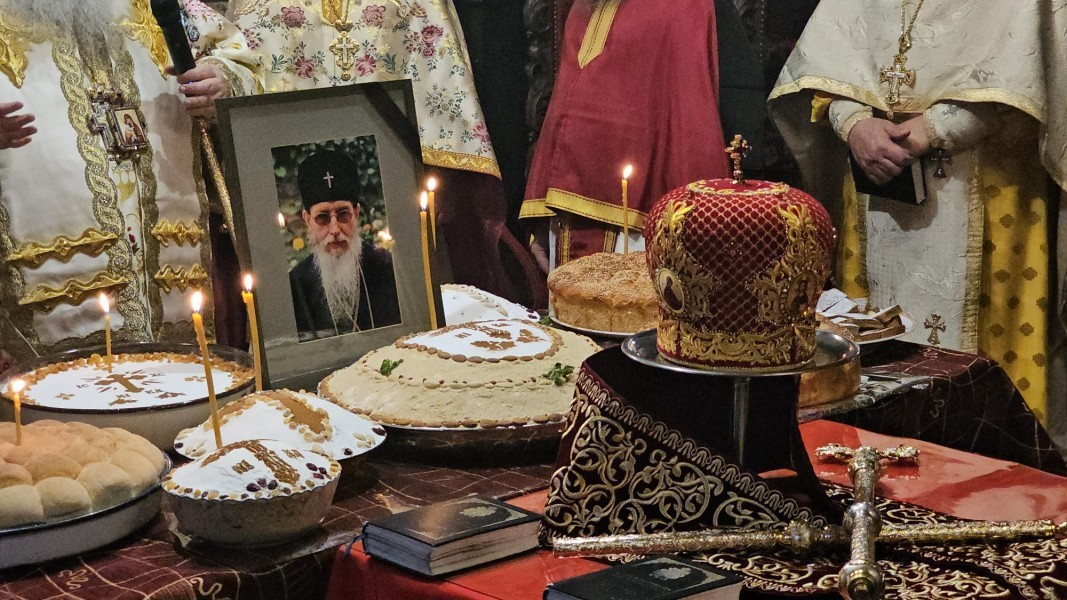
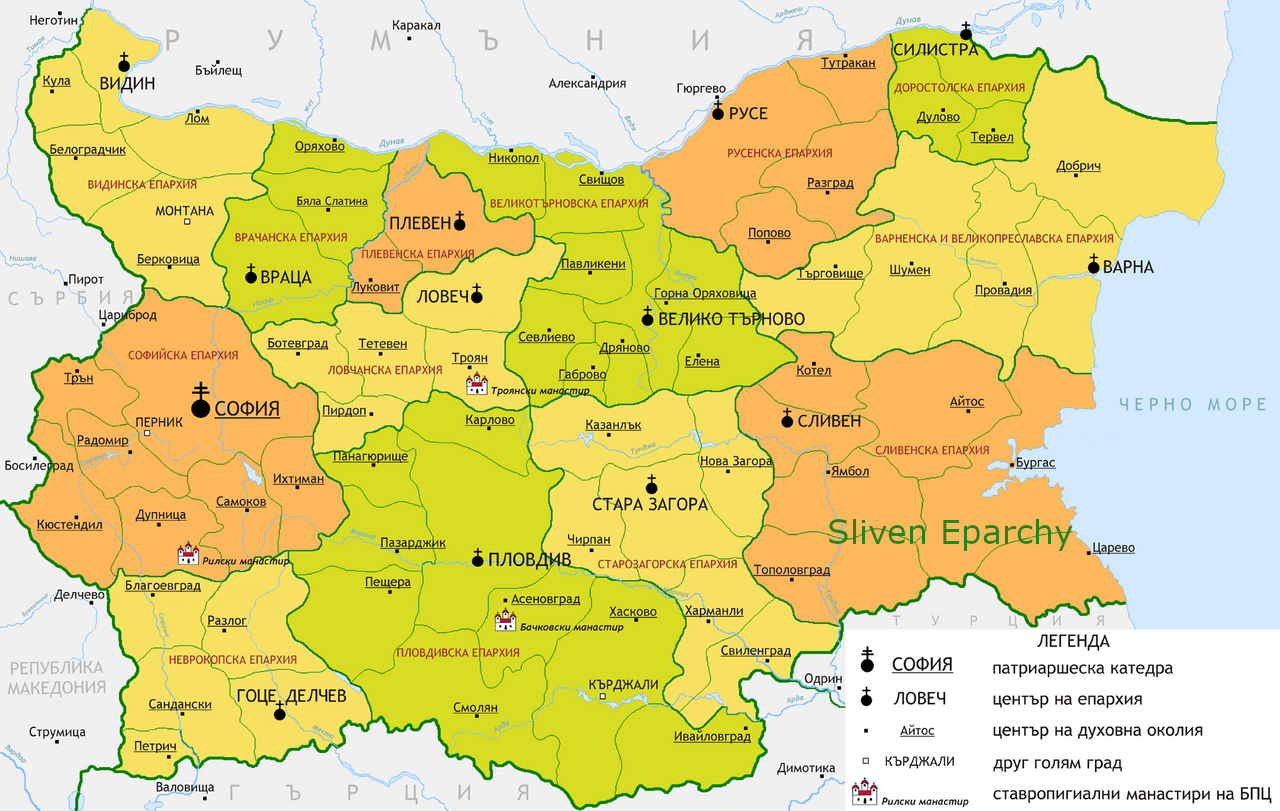
Map of Spiritual Eparchies in Bulgaria of Bulgarian Orthodox Church Bulgarian Patriarchy (BPC-BP)
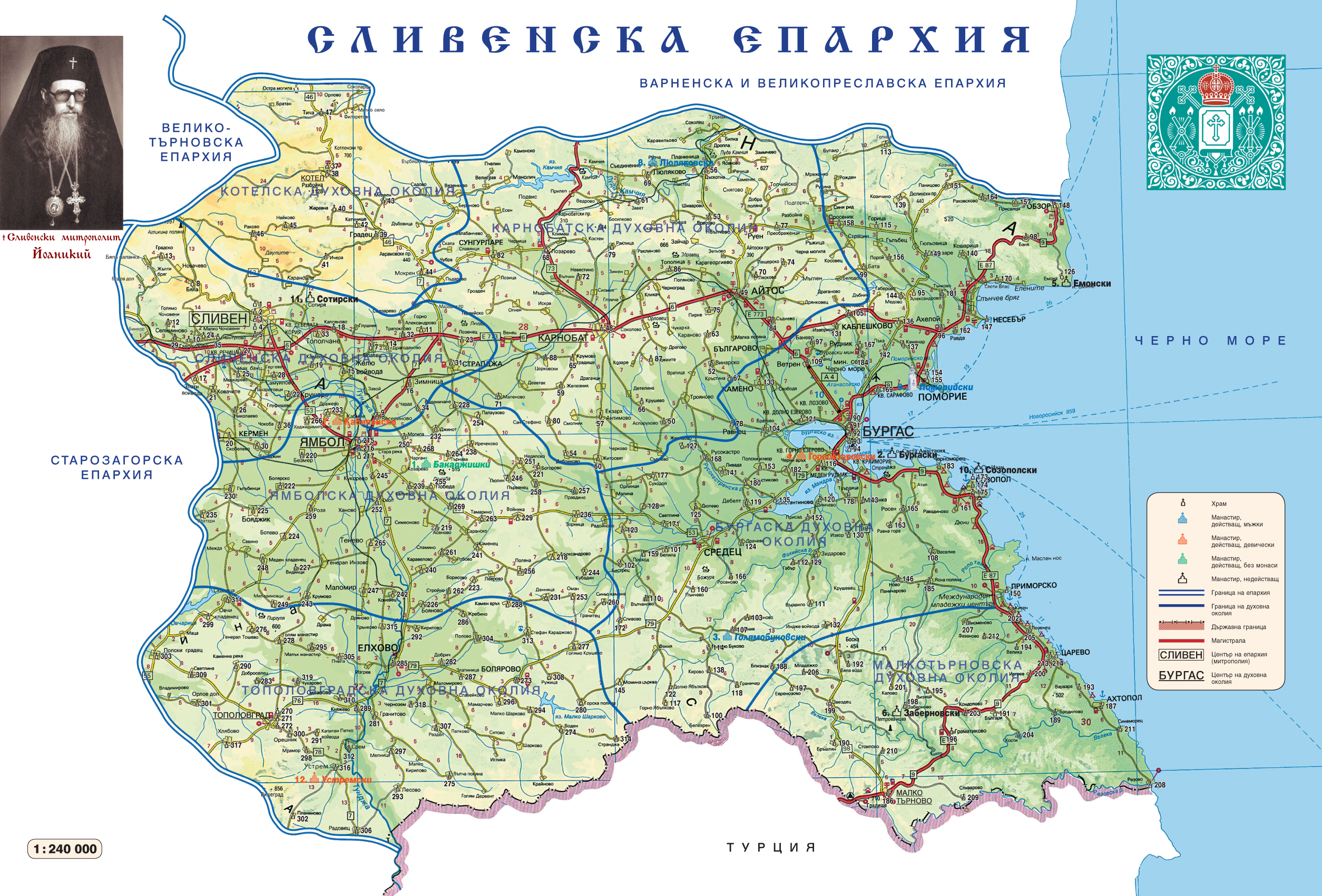
Territorial Map of Sliven Eparchy according to the Local Spiritual districts belonging to Sliven Metropoly
Shortly after, it was decided to stop the legal procedure for choosing between bishop Ierotey and bishop Michail and overwritte the Synod accepted and agreed own legal document to follow on different church casuses, the ' the Church statuses regulations (Устав на БПЦ Българска Патриаршия = Bulgarian Orthodox Church Regulation Rules document decided to be followed by everyone in the Church including the bishops and metropolitans on a National Church Assembly) rightduring a procedure for enthronization of next Metropolitan of Sliven.
The new "regulation" they tried to push "in the shadows (illegally against the Church statues)" was written in a way to make the choice of new Metropolitans to be done only by Metropolitan assembly the Synod, without taking in considerating the christian people preference for such, something scandal as this was not so during the last 150 years since we have restored the Bulgarian Church Excharchy.
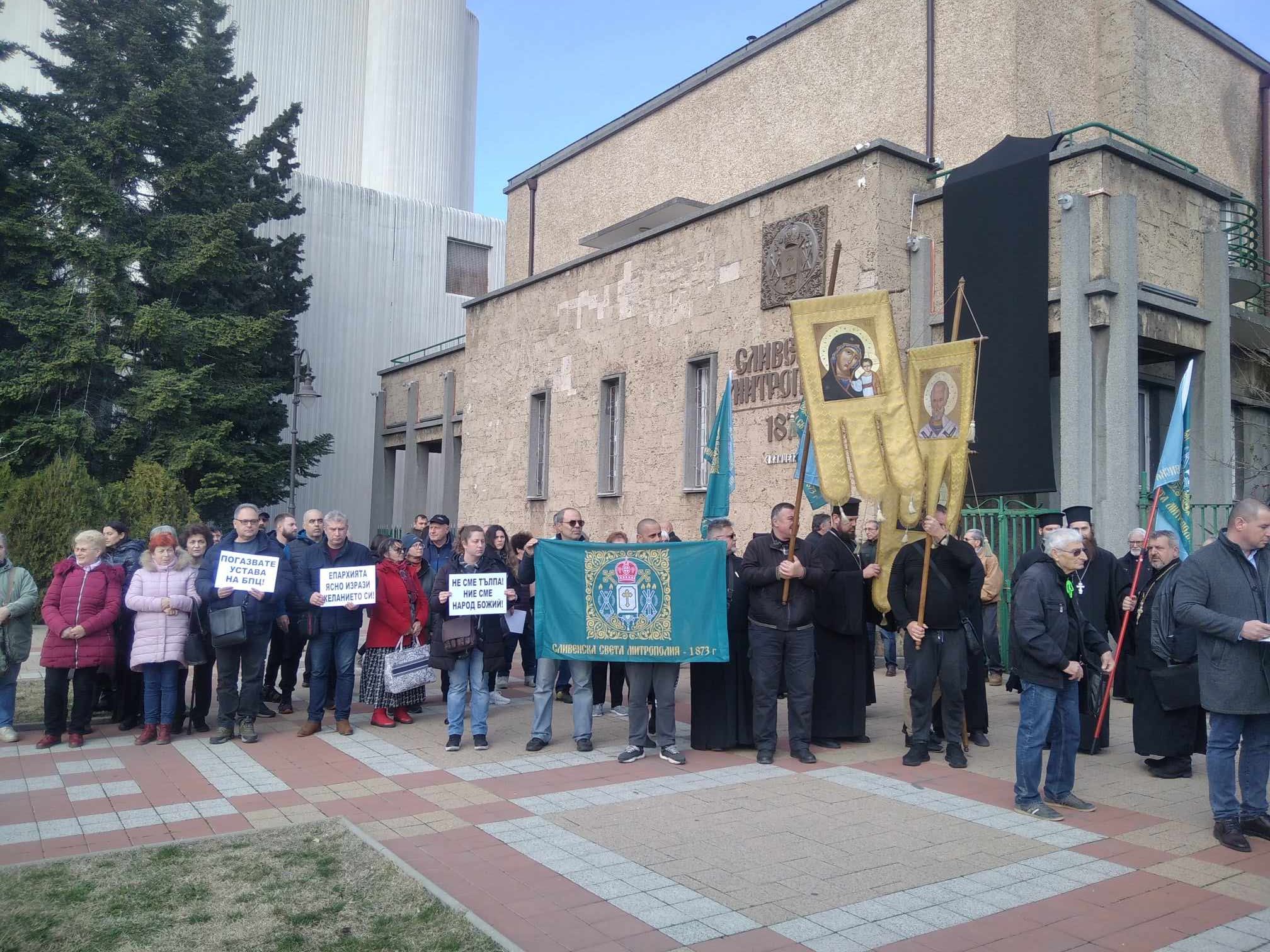
Out of this a great number of discussions started by Christian laity in facebook, viber and in the media of multitude of people, priests and cleargy from Sliven Eparchy complaining and protesting first infront of the Metroplitan Palace in Sliven
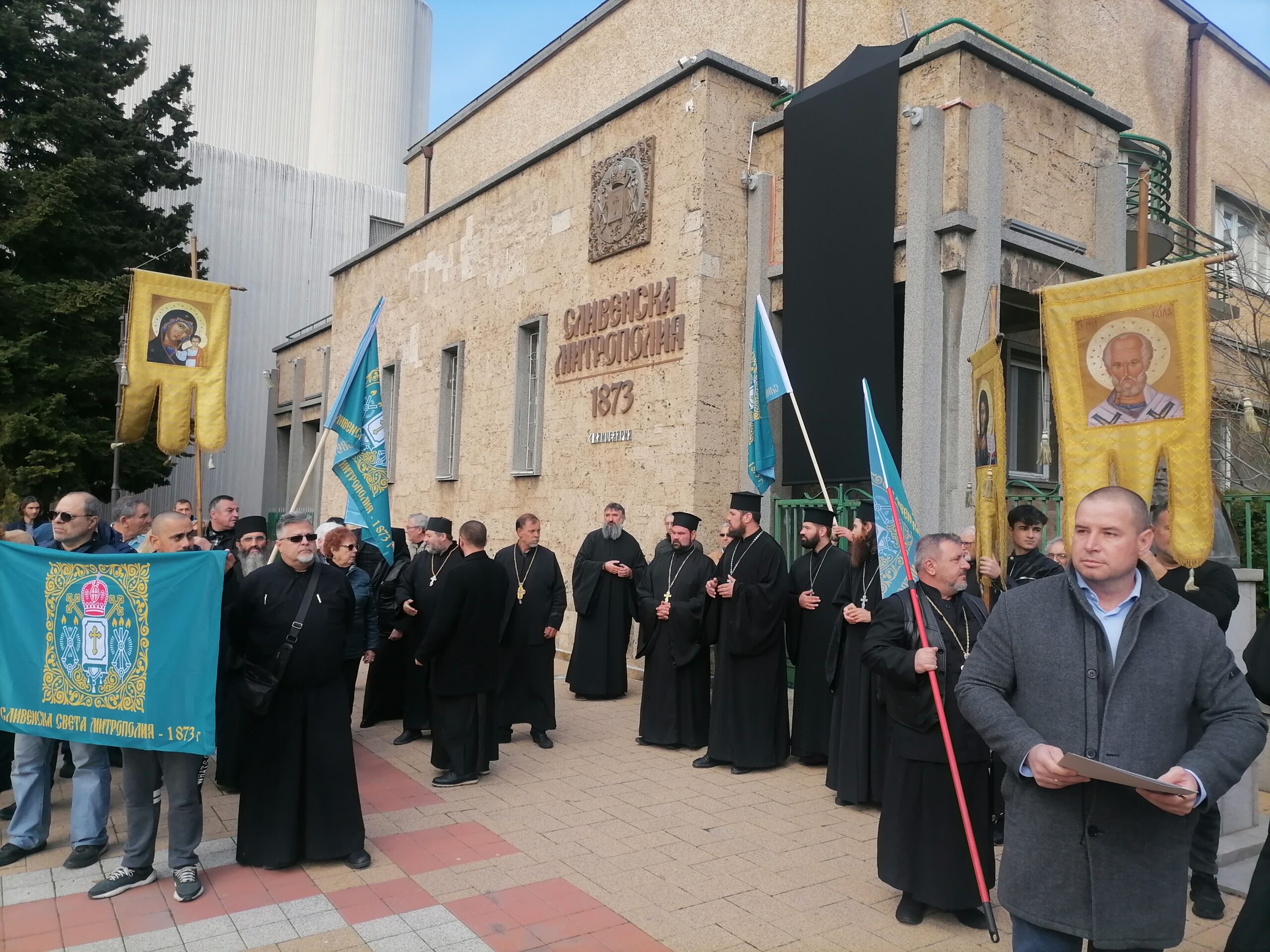
Sliven Church Priests, Monks and Layman gathered in front of Sliven Eparchy Metropolitan governing building
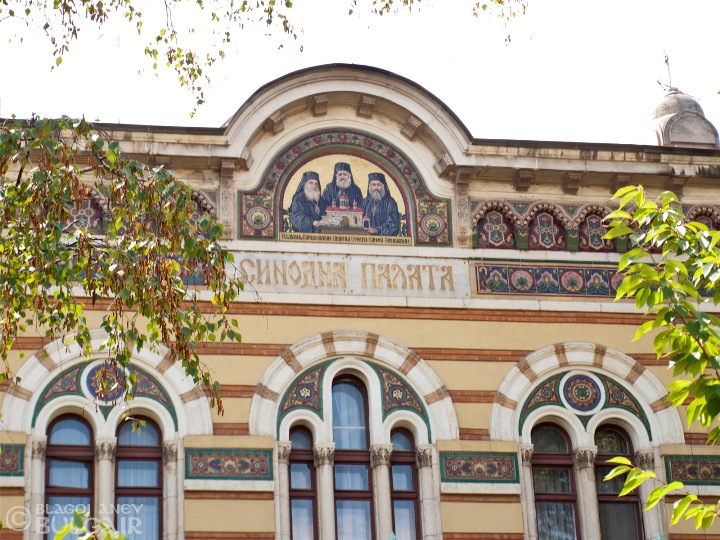
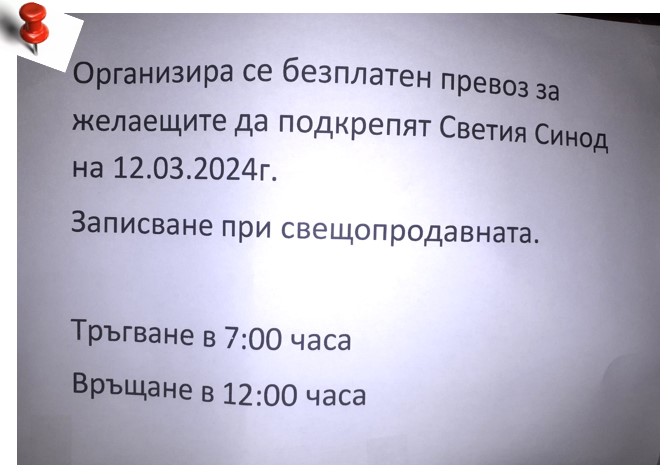
As this protests were not considered seriously by many of Elders of the Synod, the same protest with much more participant occured in front of Synodal Palace (the ruling ministry of the Bulgarian Church seat place) in Sofia as well as purely physical by presence with Prayer Vigils to the Holy Synod because of their unwillingness to accept the Synod unargumented decision to stop the procedure for choice of new metropolitan.
Peaceful objection Vigil Prayer in front of Holy Synod by Sliven Clergy and Laymen, Poster reads: "Do not exchange our Good shepherd, which gives his soul for the sheep with a mercenary, we do not know !"
Second Poster on the background is "Against the New Order", meant the new Order to not venerate People's choice during voting of new Metropolitans
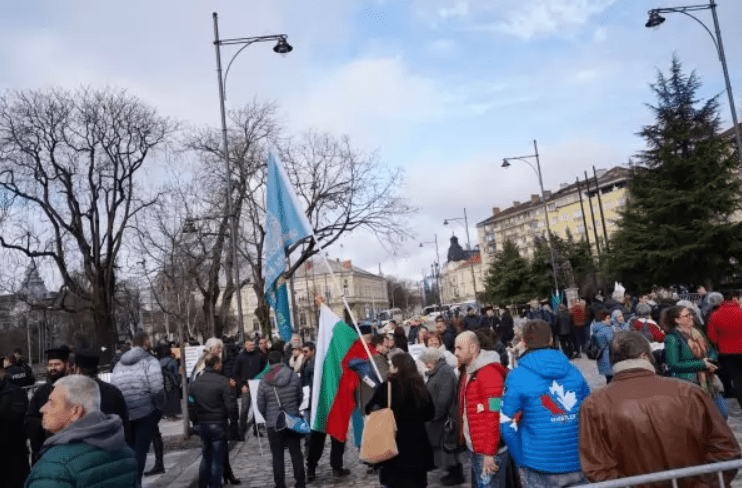
The outcome of the protest in front of the Synodal bulding palace in Sofia, Bulgaria was to cancel the votings for Metropolitan and do the whole voting procedure from the beginning.
The people accepted the decision of the Synod even though the synod took this decision to not put in place 'new order' in favour if existing norms of the Churh statuses on the background of multitude of protesting priests, monks and layman from Sliven Eparchy and other eparchies which is well documented well in below video.
Synodal Prayer Vigil against the cassation of choice for future Metropolitan of Sliven
On the protests along with Church people and clergy from Sliven was present people from other Eparchies as well as key well known priests and monks that are from Sofia and the Sofia Metropolitan to tell their unwillingness for overriding the Church established rules "Statuses", as well as to express their support for Sliven Eparchy whose Church people will is to have venerated their up to the rules selection of Bishop Ierotey to become the next Vicar (Metropolitan) of Sliven.
On many TV medias this protest was not shown and the organized fake "contra-protest" of Metropolitan Nikolay and his people who were anti-protesting against people will was shown as it was paid for that (another proof for lack of enough freedom of speech and transparency of Bulgarian mass medias).
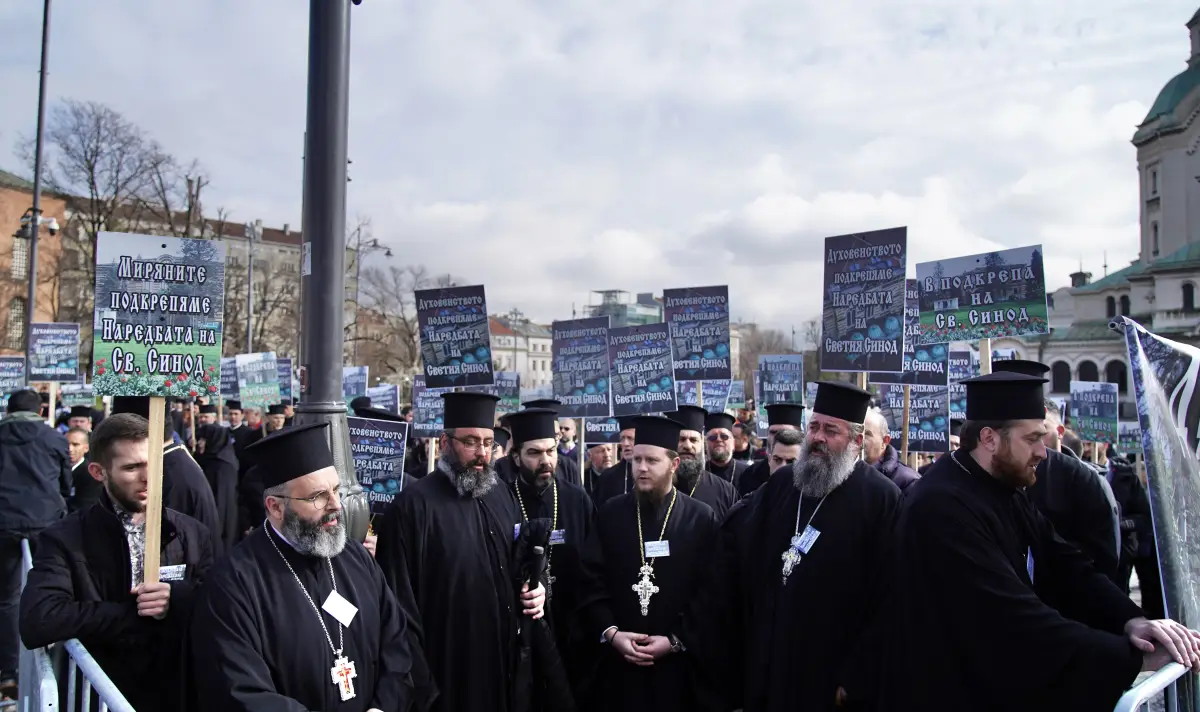
The contra-protesters from Plovdvid Eparchy that came with buses from Plovdiv eparchy enforced by Metropolitan Nikolay, very much in the old spirit of manifestations during the totalitarian regime of communism (notice the obviousness of the protest is fake from the exactly same looking slogans held mainly by priests)
As a result people from Sliven Eparchy accepted the fact that the Holy Synod decided to finally cassate (cancel) the procedure for choice of new Sliven Metropolitan and organize a new list of Worthy and dostopochteni (venerable) Bishops among which Sliven's people should make the choice again.
The people accepted this as they hoped the Holy Synod elders, might have been misled by the false accusation reports of the two brother priests Silvester and Evgeny Yanakievi (who by the way are very active on facebook) against Ierotey, and thus by organizing the choice once again officially the choice will take case in a transparent way and according to the Church rules statuses and then they can again vote for bishop Ierotey and double verify their initial choice.
However what happened now is far from that. Contrary to any logic (and as provocation), the list of venerable Bishops was made by the Holy Synod, during the Great Lent on 22 of April, a time in which people should concentrate on their repentance and spiritual growing and spiritual preparation to accept the Fest of Feasts, The Resurresction of Christ Easter.
Contrary and again unvenerating the Church clergy and people's will of Sliven the new list of Bishops does not included neither Ierotey nor Mihail and included only 6 Bishops claimed to be venerable !!!
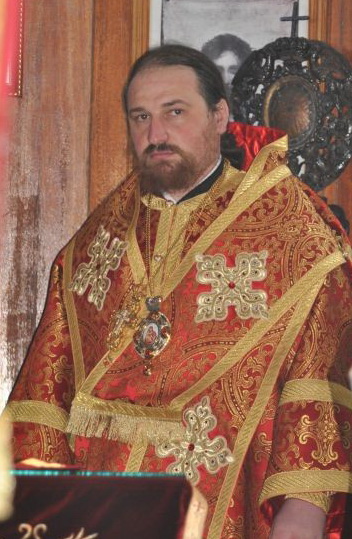
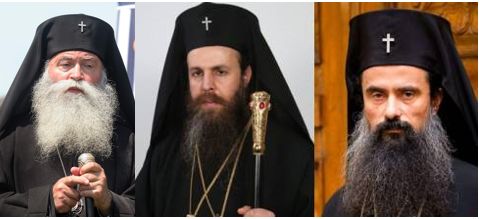
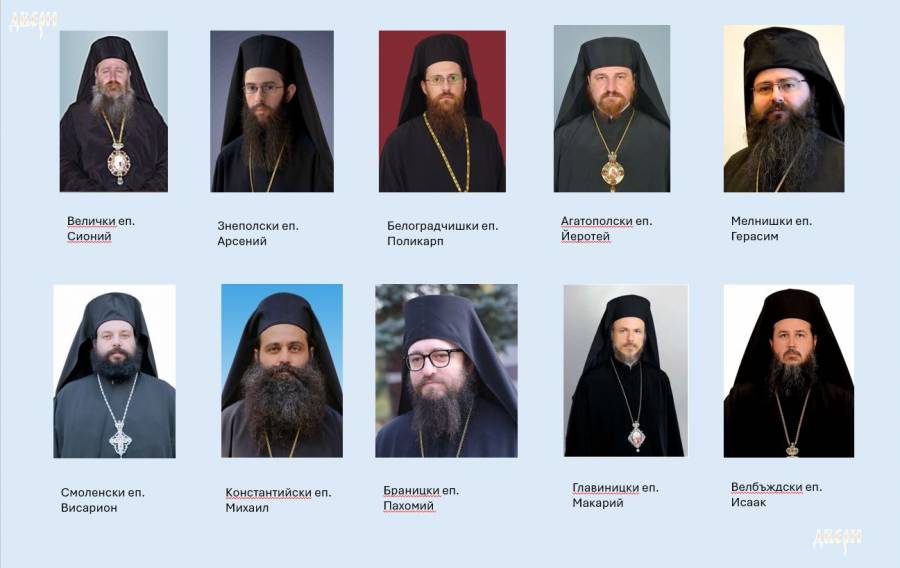
Here is a tiny biographies and only few rumored things about the Bishops, synod have been included and listed them according to seniority on when they become bishops.
1. The first listed Bishop Sionij (Velichki) completed Cherepish Spiritual Seminary (Academy) in 1990. Become monk in 1991.
Completed Theology in 1994 in Saint Kliment Ohridski. 1995-1996 specialezed in Erlangen Germany. Become monk from Metropolitan Dometian (Vidinski) in Klisurski Monastery soon after become hieromonk. In 1992 – 1995 has been abbot of Klisura Monastery. In 1996 has become deacon of Sofia's Theological Seminary Saint John of Rila (he was later removed because of scandals, a boy died and accused by pupil parents for pedophilia, a sad fact that was hidden with time, due to many publications you can find online …).
In 1998 has been raised to archimandrite by Patriarch Maxim in Dolni Lozen Monastery St. Peter and Paul.
In March 2007 has been ordinated as Bishop Velichki in Saint Alexander Nevski Cathedral. In 2009 become vicar of Vidin Metropolitan Dometian In 1 May 2014 become an abbot of Troyan monastery, 3rd April 2019 he has become an abbot also to Bachkovo Monastery.
Bishop Sionij is among the most scandalous persons in Bulgarian Orthodox Church, many media scandals assigning his name tо pedophilia and homosexuality through the time. It is claimed by medias he is involved with mafia (and especially with Church mafia). There was even a person who says to have been involved in this affairs with him that publicly has given interview for "Tzanov"'s self financed youtube channel Napred i Nagore" (video titled: "The Church of Sin").
Currently paradoxically he is an abbot of 2 of the biggest and 2 second richest monasteries in Bulgaria Troyanski and Bachkovki.. His family is known in Sofia for years for being one of the most richest people in Sofia.
Currently aged 56 yrs.
2. Second one Arsenij gruaded high school 2006 in Stara Zagora in village Osetenovo. Completed Saint John of Rila seminary in 2006, was student in Saint Ohridski Theology and continued his education in Plovdiv University, saint Paisios of Hilendar, said to have graduated 2009. Tonsured monk in 2007, became hierodeacon and consequentially same year 2008 hieromonk. 6th December he was raised by Metr. Nikolay to Bishop. He has been a director of Plovdiv's Orthodox TV since 2009 and Plovdiv Seminary 2010 (seminary initiated again by by Metr. Nikolay). In 2012 he was given to be a head of Metropolitan cathedral in Plovdvid saint Marina.
On June 2014 he was raised to bishop after offer was to the Holy Synod, by Metr. Nikolay.
Hierotony was made by then very old Metropolitan Ioanikiy of Sliven in collaboration with Metropolitans Dometian of Vidinsky (now deceased), Grigoriy of Velikotarnovsky, Ignatius of Pleven and Nikolay of Plovdiv.
Iinterestingly he is titled as protegee of Metr. Nikolay who orchestrates the decisions in the Holy Synod for the last years (fact known by most people who even had a slight idea of what is going on internally in the Church). The backstage ruling of the Synod and the place is said to be easy for the Metr. Nikolay, since patriarch Neofit was severely sick and in practice inactive as patriarch. According to official information that leaked from Synod, it was exactly Arsenij the choice of Metr. Nikolay and his group of metropolitans (most of whom doesn't have the necessery support from anyone such as DS (Dyrzhavna Sigurnost) to which Metr. Nikolay is said to have the support and in which Metr. Nikolay's father was important ranked person). Thus according to different medias the legative choice of Sliven people was cancelled by the Synod by Metr. Nikolay and his group in attempt to install the already pre-chosen Arsenij in any means.
Bishop Arsenij is known amoung the clergy in Church for becoming a bishop officially against the Church statuses, not having the Statuses set fulfilled years, becoming bishop before his 30s in 28 years, according to Church rules of statuses regulations of BPC-BP he should have had been at least 35 years, 2 more years than Christs age of crucifix. The other break of Church statuses regulations with his hierotony was that he did not have 10 years as a clergy person in Bulgarian Orthodox Church.
Currently 37 yrs old (has 10 years served as Bishop)
3. Bishop Gerasim (Melnishki) is famous for having a professional Actors education, before deciding to become monk and start his new career in the Church. He has not have officially any Theological Education diploma till the moment he decided to walk the spiritual path, but received such by specialization in Moscow 2 years in a newly created faculty by Metropolitan Ilarion Alfeev (faculty created 2012) and no longer existing. The Diplomas from Russia are not really considered officially by Bulgarian Government due to legislative reasons. Even though that he managed to be chosen somehow and become the Secretary of Holy Synod, and have signed documents that he has a higher Theological education which he at that time doesn't. He seemed to have served as a head of saint Alexander Nevsky and in this service
He is said by some medias to have closed his eyes and signed the documents for requirements of higher education for the job of Synodal Secratary as a preliminary to the function of Secratary. He is known to often serve Liturgy in the Russian Church among which was a lot of scandals last year and which kept closed for quite some time, due to clergy in the Russian Church Clergy in (Sofia) Bulgaria being accused for serving for FSB (Russian Secret Services). He is also accused by medias for organizing an official business dinner for donation to collect money from businessmen for the sake of restoration of Biggest Cathedral in Bulgaria St. Alexander Nevsky. It should be said his service in saint Alexander Nevsky as a head of it for some years was okay, no big scandals like the previous head archim. Dionisij Mishev.
Have to say it is strange why such a cathedral as Saint Alexander Nevsky, has to collect donations for its restoration, especially since the Bulgarian church Sofia Metropoly has a lot of land properties and stores on the city center that given for rent and should be bringing money to mitropoly along with the so called "vladichnina" amount of whole profit which every Church on territory of eparchy has to pay to the metropoly, especially as the Church st. Alexander Nevsky is a common tourist destination in Sofia for people all around the world and that should be supposably another way to collect money for its restoration. He is neither famous nor infamous and that is perhaps his main places of service was Saint Alexander Nevsky and as Synodal Secretary.
Currently he is aged 44 yrs. Served as Bishop 8 yrs.
4. Bishop Pahomij (Branicki) has been made a monk and hieromonk again by Metr. Nikolay, his elder was proto-abbot Benedict from Holy Mount Athos Zograph in Divotinski Monastery, near Bankya in 2002 in 2004 he become abbot of Divotinsky Monastery. For 2004 till 2010 he had managed to gather brotherhood and helped to recover a Chapel Saint Anna and rerecover the 70 Apostles Church buildings and the Main Church Holy Trinity (which is considered his greatest achievements) his fame amount the Orthodox christian youth has been positive as he managed to have a good charisma and attract young people in his monastery during his abbotship. In 2015 he become hieromonk.
bishop (hierotony by current Metropolitan of Vratza and some other bishops who is temporary substitute for patriarch Neofit's passing till the new choice of patriarch completes.). In 12.06.2017 he was made a bishop in Rila Monastery, again – according to some sources he did not have the Higher Theological education at that time for the post of bishopship, requirement according to Statuses of Bulgarian Orthodox Church. Currently he is aged 45 yrs. Served as Bishop 7 yrs
5. bishop Makarij (Glavnicki) has completed Plovdiv's Spiritual Seminary (whose deacan at that time was Bishop Evlogij Adrianopolski), finished Theology school in Bucharest in 2004 and Master degree in Thessaloniki (Solun) completed in 2010. In march 2007 become a novice monk in Rila Monastery Saint John of Rila. In 2008 during Lent become Hierodeacon, by bishop Evlogij. April 2011 become a hieromonk (priest monk). In March 2017 become a bishop. After becoming metropolitan he is now a vicar Bishop of Metropolitan Naum. He is perhaps among the most educated bishops of Bulgarian Church at present. Due to his studies in Greece, some people which play a kind of rloe of 'whisle-blower' but also do distribute some false mirrors, he might be a man of the Ecumenical patriarch.
It is interesting fact that his hierotony as bishop did not happen in Saint John of Rila monastery but in Troyan Monastery (The Old Practice of Bulgarian Orthodox Church was to create new bishops in the Capital Sofia in Saint Alexander Nevsky – nowadays changed – some speculate this is done to escape from the anaxios (unworthy) that someone might scream during the services of new hierotony to stop the ceremony). In Troyan monastery as of time of writting this article the abbot is bishop Sionij Velichki. Also it is a bit strange the person who pushed his career forward Bishop Evlogij of Rila Monastery did not take part in the hierotony in Troyan monastery.
Current aged 42 yrs. Serves as Bishop 7 yrs
6. Bishop Isaak (Velbyzhdski), started and completed aged 13 in Saint John of Rila seminary in Sofia, which he complated in 2001. In 2001 he started working in Seminary administration. Completed Sofia, Theological School saint Kliment Ohridski in 2008 (Bachelor). In 2009 in Vidin he become monk by Dometian of Vidin under spiritual guidance of Biship Sionij Velichki. In 2010, was raised to hieromonk in Saint Nicolas Church and in parallel works in Sofia Seminary as а tutor (ethnical bulgarians living abroad).
In 2011, with blessing of Metr. Dometian he has become episcopal vicar of Lom Spiritual district. In 2012 in Dormition of Theotokos Chapel (which he headed) he was raised to archimandrite. In 2012 he started studying postgraduate studies in Moscow. In June 2023 he was raised to bishop with the title Bishop Velbyzhdski and given the role of second patriarch Neofit's vicar, as first is Bishop Polikarp. According to rumors, he is said according to some media news to have some connections with FSB due to his studies in Russia (and the common Russians practice to try to recruit their students to work for Russian agencies). Also according to some medias he had public appearance speach, staying behind Russia's official position for holy war, held against the evil (Russia as a Third Rome idea which currently Russian Church embraces). Serves as Bishop 1 yr
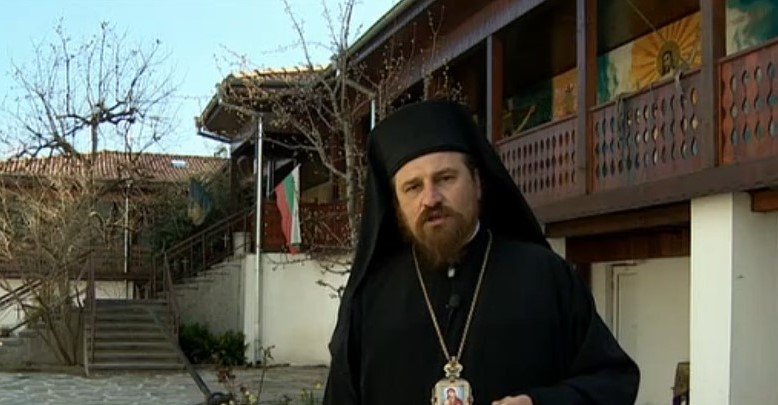
Bishop Ierotey Agathopolski (Kosakov)
The Seventh Bishop that is excluded from list, Ierotey (Agathopolski) was selected by Sliven Eparchy Priest, Monks and Laity
to become the 7th Metropolitan of Sliven is Ierotey (The Voice of the People, The Voice of God) !
Bishop Ierotey (Agathopolski) in 2003 completed, Parallel course of Sofia Theological Seminary. December 22, 2003, Metropolitan Ioannikiy (Nedelchev) of Sliven tonsured him as a monk in brotherhood of the Holy Great Martyr George in the city of Pomorie.
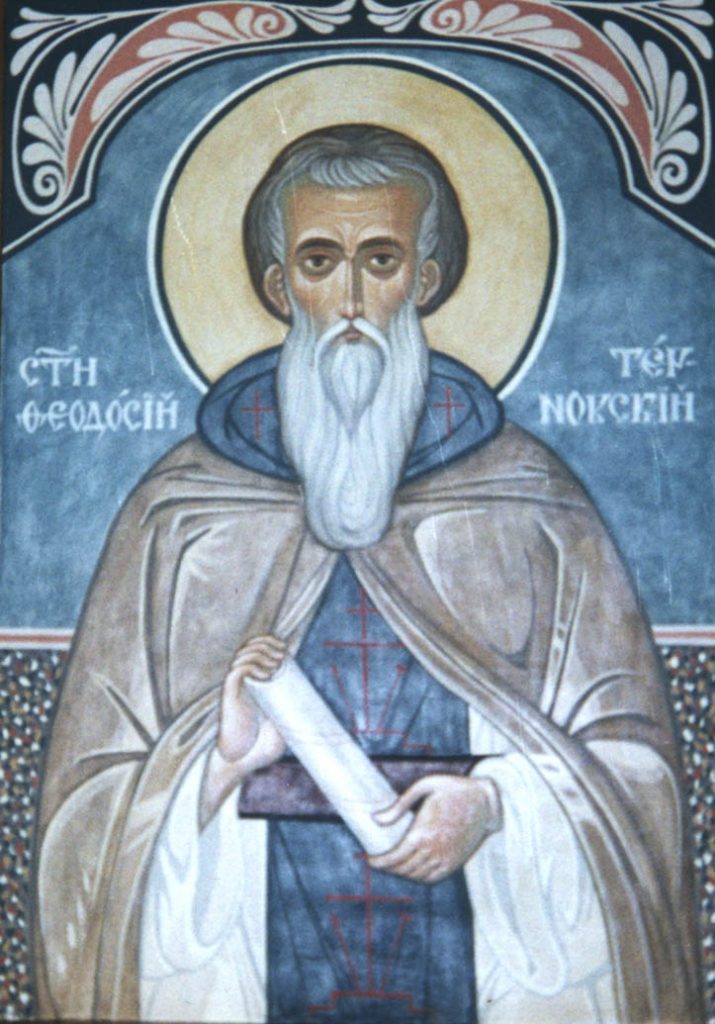
Archimandrite Theodosius (abbot of) Pomorie monastery at that time became his spiritual mentor.
May 11, 2004, Metropolitan Ioanikiy of Sliven in the Church of Saints Cyril and Methodius in Burgas ordained hierodeacon.
On May 16 of the same year, Metropolitan Ioanikiy of Sliven in the Church of the Most Holy Theotokos in Nessebar was ordained to the rank of hieromonk.
On January 1, 2005, he was appointed abbot of the Monastery of the Holy Great Martyr George in Pomorie.
He made a significant contribution to the development of the Pomorie monastery and its influence on Christian life in the region.
Christian children's camps were organized annually at the monastery, a week of Orthodox singing introduced. Many hopeless and lonely and people with problems found a hospitality and spiritual help and resort in the monastery.
On May 6, 2008 he was elevated to the rank of archimandrite. In 2010 he graduated Master Degree of Theology of Shumen University, Bishop Konstantin Preslavsky.
September 18, 2014, by decision of the Holy Synod of the Bulgarian Orthodox Church, he was elected vicar of the Sliven diocese, bishop with the title of Agathopol (Agathopolski).
October 1 was chiratonized to Bishop rank by Metropolitan Ioanikij (Nedelchev) Slivenski, Metropolitan Grogorij (Stefanov) of Tarnovo, Metropolitan Starozagorsky Galaktion (Tabakov), Metropolitan Nikolay Plovdivsky (Sevastyanov), Metropolitan Ambrosij (Ambrosius) Dorostolsky (Parashkevov), Metropolitan of Nevrokop Seraphim (Dinkov), Bishop of Trayanopol Cyprian (Kazandzhiev), Bishop of Znepol Arseniy (Lazarov).
Served as Bishop 10 years
I believe there is nearly no person who has even encountered to meet Ierotey (Kosakov) Bishop Ierotey and interacted and doesn't have a good memory of that time, or have some bad impression.
Not that I know him presonally but that person has always tried to help everyone in everything, this is really rare in our mostly egoistical world. Perhaps only envious and people obsessed with money or material goods can criticize him for the reason, he lives a true monk, and as every true monk and as Saint John of Rila adviced in His Covenant, "From all the things, most beware of money, for they are the root of all evil.".
It happens Slivens Eparchy is full of material goods due to its strategic location nearby see and due to tourism, and of course this eparchy is interested to be at the hands of businesses who can built freely and sell for cheap to big investors lands for the sake of increasement of tourism in the region, as Bishop Ierotey might be a factor against that (as he has refused to cooparete in building of 200 rooms Hotel accomodation at lands of Pomorie Monastery to Silvester Yanakiev, now there are some people leading fierce company to remove him from the vote and destroy his good name reputation.).
From the Holy Synod, there is no official explanation on why Bishop Ierotey is removed from the vote list during the new choice, but for everyone who has even the slightest idea of what is going on in the Church higher stages of power it is fully clear.
The wing of Metropolitan Nikolay and his protegees Metropolitans has risen their voices against the inclusion of Ierotey in the list. In order to make it not clear that Ierotey is the real target, few others were also removed who were in practice "un-votable" as their personal life has spots.
This just like the first time of decision to halt the process of voting even thugh two candidates for metropolitan were chosen (none of which that seems to fit the desires of the Dark Cardinal of the Bulgarian Church Metr. Nikolay and his synodal group of dependent people who are kept silent and obedient due to compromates against them or with financial donations).
It is not secret and not new the backstage dictation of Metropolitan Nikolay to his band (Synodal wing) of bishops many of whom are known to have a lot of homosexual (homophilia) and even pedophilia and other abnormal sexual activities, as well as activities related to the dark business schemes in bulgarian businesses and money laundary for which people know from mouth to mouth information spreading for years in the Church.
What is now stunning is that these people has become so unscrupulous, that they're ready to get over any person or group of people and even against a whole Eparchy of the Bulgarian Orthodox Church that perhaps nominally might be around 1 million people !!!
These peoples's believe, that us the ordinary believers of the Bulgarian Orthodox Church are stupid and easily managable and they can do with them whatever they want because they're a higher class and very few of people are really regularly going to Church or actively parcipating in the Church Mysteries (Holy Communion and the other 7 sacraments).
What is striking, the Synodal elders are shameless, they think they're the Church, forgetting the word Ecclesia meaning.
"Ecclesia (or Ekklesia) in Christian theology means both: a particular body of faithful people, and the whole body of the faithful."
Seems like now our many of our Synodal Elders understand the Church (Ecclesia) as them and the servitude of faithful to Christ people who should obey them for the only reason, they have taken the seat of the Holy Apostles (that is the metropolitan seat = bishopship seat + administrative obediences).
It is interesting to say the modern understanding of Ecclesia in Western Modern Catholicism does well fit the understanding that the powerful of the day in the Synod that are trying to push out their agendas against the people will and choice, below is a definition.
Christian understanding of Church
If one speaks of the whole body of Christian faithful, then there are included not only the members of the Church who are alive on earth but all who were members of the church before. Some churches therefore describe the Church as being composed of the Church Militant (Christians on Earth) and the Church Triumphant (Christians in Heaven). In Catholic theology, there is also the Church Suffering (Christians still in purgatory).
The Christian family, the most basic unit of Church life, is sometimes called the domestic Church.[2]
Finally, 'The Church' may sometimes be used, especially in Catholic theology, to speak of those who exercise the office of teaching and ruling the faithful, the Ecclesia Docens, or again (more rarely) the governed as distinguished from their pastors, the Ecclesia Discens.
What else is really not Okay with how the selection of Bishops are reduced from 10 to 6 venerable to take the seat of Sliven Metropolitan
All this events happen during the Great Lent and for every True Christian it is well known the old Church practice, that important decisions should not be taken during the great Lent period as usually such decisions are wrong and could create havoc, due to the highest degree of temptations that are let around by the Almighty God for the spiritual grow and healing of his faithful childs the Christians.
It is up to Christian people to now proof them once the Great Lent is over after the Glorious Resurrection Day they're wrong and that people will not let the God given eparchy of Sliven to be ruled by dependent Metropolitan to Metr. Nikolay.
It is up to us to proof we're not sheepsand that people's will on matters of higher hierarchy of Church and their deeds should not be unmonitored and unpunished as it was in a higher degree over the last years !!!
People should rise of their indifference and show they still care about the Pureness of the Church and the legitimity of the Church Law of Selection of new Highest Hierarchical heads of the Church.
It is last time and last chances until we still have Church, especially considering the Apocalyptic times in which we seem to be living.
If you dear brothers and sisters in Christ not react and not fight for the truthful selection of a list with really venerable bishops that is transparent and argumented as it should be, another satellite Metropolitan will be installed to fit the plans of the ex-communist DS (Dyrzhavna Sigurnost) and the Ruling elite. If that happens soon we'll not only have a Real Orthodox Church Hierarchy chosen according to canons and due to Church Statues as it should be but an Assembly of Pseudo Hierarchs who acts in secrecy and conspiracy schemes in the same way as any Masonic Lodge.
In other words, we'll have Church but a faked artificial business and party like organization, where decisions are not taken by the Creator of the Church the Lord Jesus Christ and his true followers the Apostles (that are the Bishops and Metropolitans), but we'll have a secular organization with Big beauty Church temple (museums without real cleargy) and a Monasteries full of pedophiles, gays and people who want to live an easy life and enjoy themselves instead of spiritually persevere and lead the hard spiritual fight and pray for the well-being of Bulgarians, Bulgaria and the Rest of the Christians.
Lets pray fervently until the end of the fasting, that the Metropolitans who took that bad decision will change their mind and put back in the list the real venerable people and not have a list of people who are dependent and unworthy due to lack of Higher education, a personal scandals, they were involved like Bishop Sionij or have another kind of spots, that can be easily researched even by a simple few Internet searches in Google.
Nomatter who is worthy or not, the main thing is that Sliven Eparchy should be headed by a person who is wanted in the Eparchy and such person according to the clear votes of Eparchical electors is Ierotey, the problem is that Ierotey is not playing well with the dark businesses and does count the interest of people, and does not randomly do what is being asked for with the only goal to make money and he doesn't follow blindly rules by Metr. Nikolay or whoever else that is not working for the good of True Church of Christ (the assembly of all people believing in Jesus Christ as we theEastern Orthodox believe) and thus he is automatically becoming unworthy. As worthy is considered those who serves the Business and the Internet of the powerful authorities of this day.

I've been given a very tedious task to Copy music from Audio CD Drive to MP3 / MP4 file format and then copy the content to external Flash drive.

Doing so is pretty trivial, you just need to have a CD / DVD rom on your computer something that becomes rare nowadays and then you need to have installed a bunch of software, if you don't already have it as i've pointed in my previous article Howto craete Music Audio CD from MP3 files, create playable WAV format audio CD Albums from MP3s.
Creating a Audio CD from an MP3 collection is exactly the opposite to what is aim't now (to copy the content of a CD to a computer and prepare it for A Car MP3 player).
1. RIPing audio CDs to WAV and Conver to MP3 from terminal
On Linux there is many ways to do it and many tools that can do it for your both graphical and command line.
But as I prefer command line to do stuff, in this article I'll mention the quickest and most elementary one which is done in 2 steps.
1. Use a tool to dump the CD Audio music to Tracks in WAV format
2. Convert the WAV to MP3 format
We'll need cdparanoia tool installed as well as ffmpeg.
2. RIPping audio CD on Linux with rip-audio-cds-linux.sh script
#!/bin/bash
# A simple shell script to rip audio cd and create mp3 using lame
# and cdparanoia utilities.
# —————————————————————————-
# Written by Vivek Gite <http://www.cyberciti.biz/>
# (c) 2006 nixCraft under GNU GPL v2.0+
# —————————————————————————-
read -p "Starting in 5 seconds ( to abort press CTRL + C ) " -t 5
cdparanoia -B
for i in *.wav
do
lame –vbr-new -b 360 "$i" "${i%%.cdda.wav}.mp3"
rm -f "$i"
done
If you need to automate the task of dumping the audio CDs to WAV and convert them to MP3s you can do it via a small shell script like the one provided by cyberciti.biz that uses paranoia and lame commands in a shell script loop. Script rip-audio-cds-linux.sh is here
3. Dump Audio CD to MP3 with Graphical program ( ripperx )
By default most modern Linux distributions including the Debian GNU / Linux based ones has the ripperx in the default repositories, as well as the tool is downloadable and compilable from source from sourceforge.net
# apt-cache show ripperx|grep -i descript -A3 -B3
Architecture: amd64
Depends: cdparanoia, vorbis-tools (>= 1.0beta3), libatk1.0-0 (>= 1.12.4), libc6 (>= 2.14), libcairo2 (>= 1.2.4), libfontconfig1 (>= 2.12.6), libfreetype6 (>= 2.2.1), libgcc1 (>= 1:3.0), libgdk-pixbuf2.0-0 (>= 2.22.0), libglib2.0-0 (>= 2.16.0), libgtk2.0-0 (>= 2.8.0), libpango-1.0-0 (>= 1.14.0), libpangocairo-1.0-0 (>= 1.14.0), libpangoft2-1.0-0 (>= 1.14.0), libstdc++6 (>= 5.2), libtag1v5 (>= 1.9.1-2.2~)
Suggests: sox, cdtool, mpg321, flac, toolame
Description-en: GTK-based audio CD ripper/encoder
ripperX is a graphical interface for ripping CD audio tracks (using
cdparanoia) and then encoding them into the Ogg, FLAC, or MP2/3
formats using the vorbis tools, FLAC, toolame or other available
MP3 encoders.
.
It includes support for CDDB lookups and ID3v2 tags.
Description-md5: cdeabf4ef72c33d57aecc4b4e2fd5952
Homepage: http://sourceforge.net/projects/ripperx/
Tag: hardware::storage, hardware::storage:cd, interface::graphical,
interface::x11, role::program, scope::application, uitoolkit::gtk,
..Both on his father's and on his mother's side, he came not from a simple, but from a very good and honorable family, known first of all to God, and then to the king and to the whole Thessalonica (Solun) region, which was also evident from his appearance. That is why the princes, who loved him since his childhood, held dignified conversations with him.
Finally, the king, learning of his abilities, gave him the rule of a Slavic principality – as if he foresaw, I would say, that he would send him as a teacher and first archbishop of the Slavs, so that he could learn all their customs and gradually come to love them .
Having spent many years in this principality, and seen many tumults and crimes in this life, he exchanged his aspirations for gloomy earthly affairs for heavenly thoughts; for he would not trouble his noble soul with things that do not abide forever.
Having found a suitable occasion, he released himself from the princeship, and going to Olympus, where the holy fathers lived, he cut his hair, put on a black garment, and obeyed obediently, fully fulfilling all the monastic rule and diligently occupying himself with books.
When some occasion arose, the king sent his brother [Constantine] to the Khazars, and he took him with him to help. Because there were Jews there who blasphemed the Christian faith very much.
And he said, "I am ready to die for the Christian faith," and he did not disobey, but went and helped his younger brother as a servant, obeying him.
And so he by prayer, and the Philosopher by word, overthrew the Jews and put them to shame.
...And then God revealed the Slavonic writings to the Philosopher, and he, arranging the letters and composing the [Gospel] discourse, took the road to Moravia, taking Methodius with him. And he again began to obediently obey and serve the Philosopher and teach with him.
… After many days, when the Philosopher was about to appear before [God’s] judgment, he said to his brother Methodius: "Here, brother, we were a pair harnessed to draw a furrow, and I, having finished my day, fall into the fields .
You, on the other hand, love the mountain too much; but do not forsake your teaching for the sake of the mountain, for by it you can better be saved.”
…On all the roads, he fell from the devil into many calamities: in desolate places – among robbers, on the sea – in violent disturbances, on the rivers – in sudden sandy shoals, so that the apostolic words were fulfilled with him: "Misery from robbers, miseries by sea, troubles by rivers, troubles by false brothers; in labors and pains, often in vigils, often in hunger and thirst," as well as other afflictions that the apostle mentions.
Then, putting aside all [life’s] noise, and entrusting all his cares to God, he first appointed from among his disciples two priests, good scribes, and quickly translated from the Greek language into Slavonic all the [Bible] books in their entirety, with except the Maccabees, for six months, beginning in the month of March until the twenty-sixth day of the month of October.
When he had finished, he gave worthy praise and glory to God, who gives such grace and such quick success. And by serving together with his clergy the holy mysterios elevation, he celebrated the memory of Saint Demetrius.
Because before that he had translated together with the Philosopher (Kiril) only the Psalter, the Gospel with the Apostle and selected church services. And now he also translated the Nomocanon, that is, the church rules, and the books of the Fathers…
He took, therefore, that the time was approaching for him to receive rest from his sufferings and a reward for his many labors. … On Palm Sunday, when all the people had gathered, he entered the church and, although weak, pronounced blessings for the king, for the prince, for the clergy and for all the people and said: "Keep me, children, until the third day." So it happened.
On the third day at dawn he said: "Into your hands, O Lord, I commit my spirit," and he died in the hands of the priests on the sixth day of the month of April, indict three, in the year six thousand three hundred and ninety-three (6393) from the creation of the whole world, ( 885 A .D.).
His disciples placed him in a coffin, gave him due honors by performing a funeral service in Latin, Greek, and Slavonic, and laid him in the cathedral church. And he joined his fathers and the patriarchs, the prophets, the apostles, and the martyrs. An innumerable people gathered, people who saw him off with candles, weeping for the good teacher and shepherd: men and women, small and great, rich and poor, free and slave, widows and orphans, foreigners and natives, infirm and healthy – all [lamented] him who was all things to all, that he might win all.
Excerpt from writtings of Saint Clement of Ohrid:(St. Kliment Ohridski)
From "Extensive Life of Archbishop Methodius"
Translation of Hristo Kodov based on the text of theAssumption Collection from the 12th-13th centuries.
Old Bulgarian literature. Volume IV. Biographical works. Ed. "Bulgarian Writer", Sofia. 1986
(See the full text in Bulgarian – HERE
Troparion of St. Equal to the Apostles Methodius
Through Your Saint Methodius, O Christ, grant mercy to us who perform the bright celebration of his Assumption, open the doors of the Kingdom to us, free us from the chains of our many sins, and through his intercession, Lord, have mercy on us.
Kontaktion
Let us praise the divine and faithful Methodius, people, and praise him with love as a great shepherd of the Slavs, an honest servant of the Trinity and a banisher of heresies: he prays unceasingly for us all.