I'm trying to graduate for a really long time, so far. Let me in short perephrase my story, as I'm sure there are probably plenty of people out there who are into the same shitty situation as I.
I graduated school while being 17 years old (one year earlier than supposed), studied in a Mathematical oriented High School with majors Informatics and Mathematics with itensified English language studying.
While turning 17 I had my regular fancy-dress carnival (ball) as we have it each year near the end of May and beginning of June in Bulgaria, in those joyful times plenty of High School graduates has their celebrations. I don't know how it is in other countries but in Bulgaria, graduates are often mislead and does not have clear idea what exactly they want to study, because schools do less to properly orientate the student on what kind of study stream field or what kind of sphere of life he would like to be employeed (maybe it was just my alumni) or the alumnis student generations that emerged just 10 years after Communism regime fall, maybe it is just my individual case. Or maybe it was like this everywhere? Anyways I graduated desiring only to study informatics for the only reason, Informatics was fashionable and it was thought the future of existence will be fulyl pre-dominated by informatics. Therefore in my school me and many classmates thought graduating in informatics is the best thing one can do. Computers back in the day was not so heavily spreaded (every person did not have a computer), so still computers were perceived by Bulgarian people with high dose of mysticism and interest. And those interested in computers were much more interested into learning something and much less consumer oriented society … but doesn't matter, I can write a lot of this but will stop here as this is not the ultimate goal of this article ….
Once graduating in PMG Ivan Vazoff – The High School where i graduated, I tried to apply for a student by following the standard student entrance exams for the study stream of Computers and Information Technologies as this was my primary field of interest back in the day. Back in the day the only way to enter for study stream of Computer Engineering was lay exam solving 4 mathematical complex problems, mathametics. I'm a very bad mathematician and bad in counting, since my childhood I guess I had some bad teachers which didn't spend enough time explaining, I was lazy or just I don't have the talent to be good in mathematics, so following the exams in few mainly Technical Universities in few Bulgarian cities produced no good results. Because of my bad exam marks (my best one was 3 out of 6, where 2 is negative and 6 is positive – yeah the standard education system in Bulgaria is from 2 (poor) to 6 (excellent), I was not accepted in any of the universities to study informatics. You can understand my high disappointment, I was so keen to study informatics really! but the stupid system never allowed me to do so! Hoping I will be able to transfer to another study stream I signed in Varna TU (Technical University) in a study stream called "Machine Building and Instruments Construction". I was received in student with a very low mark of just 3 out of 6, there was practice back in the day that the students with worst marks entered into the Machine Building and Instruments Construction or Automation specialties. I was a total user, as the name of the specialty sounded not so bad and I hoped the specialty should be closely related to Informatics, I had hope. Spending just the first semester in the University I realized this specialty – as it was taught back then has almost nothing to do with Computing; besides that it had plenty of Engineer Drawings. As a graduate from a High School where accent was Mathematics, I never did even one Engineer Drawing! So it was a complete, mess I tried hard to learn it but it was not possible, even though I tried my best I couldn't properly Draw. After all I never had the habit and even the basic knowledge on How Engineer Drawing is done. It was sad and stressful times, besides that I had to follow two University Higher Mathematics (Chapter 1 and 2) in 1st semester and University Technical Mathematics (Chapter pt. 3 and 4). First semester I couldn't pass Mathematics exam 1 and 2. Because of the reason the teacher was mostly terrible in explaning and also the level of mathematics required to know was very high; for me it was even harder as I never ever had good understanding or knowledge in mathematics. I failed the exams I hardly passed 2 out of 4 exams, I had troubles with few subjects certification (in those university studyign students, had to be certified by the teacher to go to the exam – if you don't attend the lectures you don't get certification and you can't go for the exam). It was a mess. After the end of 1st year I realized, I cannot in any way make it, to move myself to study in some study specialty that has to do more with Computer Science, so I stopped studying.
During the summer I visited some private Mathematics lessons and tried my best to apply again to study for informatics this time for another University (The Economic University of Varna). Though my hard attempts to learn a set of model mathematical tasks to solve, on the exam in June I only could achieve again a low mark 3.80 out 6. I needed at least 5 in order to be approved to enter the pre-selected number of students which would study Informatics. Here a note to make here is most of the students who studied informatics did not hold even basic understanding in computers or did not even been keen on computers ….
So in practice again I couldn't enter the study stream I wanted so I was accepted in a study stream called Commodity Knowledge (which consisted of a lot of Chemistry doing chemical analysis of products testing, if they're suitable for putting in store things like this). As a bad mathematician my knowledge in Chemistry was also not good, not to mention I had a very short life memory, so sciences with a lot of formulas (and a lot to remember) are so unsuitable for me …. Anyways I was trying to be very diligent in this Commodity Knowledge study, and I could even pass all my exams in the first year with not so bad overall marks of around 4.30 out of 6.
I should say I spoke with administration and in first semester I was told it is possible to transfer in Computer Technology specialty if I have relatively good marks, they blutantly lied to me, since after talking with them in the end of the first year I was told the two study systems of Commodity Knowledge and Computer Technology has difference, so the only option is to start again from year 1!!!!! I was mad and disappointed, but decided to just study Stock Knowledge for the reason I already started it with hard intention this time I will graduate. Somewhere in the middle of year 2 in University, I was totally pissed off the studies, besides that at home there were plenty of family problems, so I was devastated. My mother and father was hardly urging me to find a job immediately because they cannot (or will not) financially support me anymore. After some search on the Internet I was referred by a friend (from my school years who lived in Sofia) about a company called Design.BG which is looking for a Linux system administrator. I already had plenty of experience with Linux and Operating System as this was my hobby and most of my free time was invested in learning Linux, advancing my knowledge in Operating Systems, learning Computer Programming etc. etc. I went to the interview and was approved !!! Hooray I had job but I was paid a very funny money 250 lv (125 EUR) – of course I was just starting in this job but come on 125 EURO for a system administator responsible for 6 servers – 125 EURO per month was meakly ridiculous….
I worked in this company Design.BG for overall of 7 years. After 4.5 year of working and a working sallary of 450 lv I just quit, they were plainly using me as a Robot is used, ridiculous and stupid. I had some good times in the company made some friends, advanced my knowledge this is true. But after all after 4.5 years working in an office I had neither savings, neither achieved something and living on rent – working month by month for my rent and monthly food (very similar to people in Africa). A friend of mine who lived in Dobrich and also was very disappointed from his started Education and quit, told me he will be signing to study in a (comparatively new College) located in Dobrich (Holland-Dutch College ICA – International College Albena). I went to this college and signed up for the studies, usually the students were asked to study 1 preparation year, because they need to advance their English (all subjects were taught in English). As I had a relatively normal English I went to an interview in the College and to one Intelligence test exam and I was approved to start studying immediately without following preparation year 1.
The days while being in the College was relatively good, as somehow I managed to pass two years there in the specialty of International Business and Management (IBMS). After year 2 it appeared there was not enough students in my student group, so there couldn't be year 3. We were only 6 students in IBMS and 3 of them had plans to transfer to continue their studies in another Business School (Arnhem, Business School) in the Netherlands. I was again in a difficult situation, from one side I wanted very much to go and see how living is abroad from Bulgaria, since I never went out of Bulgaria, but from other side I didn't have enough money to do it, so I had to ask for financial support from my parents, I went to banks asking for Student Credit but since my parents had little of earnings, the banks were not willful to provide me a student credit of 10000 lv. (5000 EUR) which even will not be enough for graduating; however I was dreaming to go and study abroad so I make plans that I can gradute with maybe only 7500 EURO. It was just after I realized how my plans are wrong I needed much more to graduate. The good news I had job as I continuously worked for Design.BG (as remote system administrator). so I was earning 650 euro – a money I hoped will be enough to support my studies, as well administrating few other Servers for Winner Ltd (a smal.l company started and owned by my best friend from my youth years). After a lot of "disputes" with my family
I was able to convince them to help me with money to go to the Netherlands.. I went here in Holland, thinking it is all like a bed of roses. I thought here I will be able to find a good job make a good earning. But guess what it was nothng like this. I realized it is pretty hard to find a good job in Netherlands, besides that Bulgaria was not in Shengen so we Bulgarians could only work if we have a special issued work permit document – the Employer however issues this only in case if there is no suitable Dutch person for the job + issuing this document is often seen as problematic by employeer. Thus as a consequence most of Bulgarians even if they find job have to "work in the dark" in the grey economy without being officially employed with a contract or paying a social security or taxes. Such kind of jobs are mainly provided by Turkish or Kurdish and often even those who get job are underpaind or the employeer lies him with money, and you have nothing to do since officially you have no employment contract ….
I signed up for itjobboard.nl a website providing some resources for people who are involved in IT searching for job but nothing decent poped up.
In Arnhem Business School I signed up under Human Resources and Quality Management specialty – this was one of the biggest mistakes in my life (from current perspective) – was always interested in social studies, so I thought HR will be good. However it might be, but the people I meet in face of teachers in University of Arnhem and Nijmegen (ABS) in HRQM was a hell. They were even worser than the ones in Bulgaria (and I always thought in Bulgaria people are narrow minded), here in Holland they were even more narrow minded. They were preaching what they believe, trying to impose themselves on the student constantly trying to manipulate you. Trying all kind of techniques which are against the normal people code of ethics. Experimenting hardly with experimental Psychology, Hypnosis, NLP – what can I say just a bunch of totally crazy ungodly people. Education, here in the Netherlands was a hell.
Teachers didn't care for the student even more than they don't care in Bulgaria. Teachers failed to identify brilliant minded students, but was forcing ahead only students, which somehow was pretending to be smart. Besides that my colleagues in study group's IQ and experience was far from the even minimal for a serious study and scientific thinking (of course this are just my 5cents), I had troubles with money. What made it even more of a nightmare was the fact in Netherlands people though being smiling and ethical was not too much believing in God and there was no regular Orthodox Church services. There is just one Orthodox Church here in Arnhem and they had 1 Church service per month …. I have studied plenty of Bullshit subjects in Arnhem Business School. The only so-so reasonable was Counceling and International Labour Law. What made my studying situation even more hellish was the fact. The subjects taught here in Arnhem Business School are not identical as content to the ones I was taught over the 2 years I studied in Holland-Bulgarian College (International College Albena). The style of teaching was also very different. Here the student is left on his own to spend his nerves on shit issues, most of which are caused by the badly architectured university system and the unwillingness of teachers to be helpful to students. From my overall experienced in Arnhem Business School in HRQM. I urge you don't sign and Study for HRQM. This might be the biggest mistake you will make. The nerves,. the lost times and the brainwashing you're about to get with a shit content is not worthy the time and the price of tuition fee of 1672 euro per year. I've studied 1 year here in Arnhem Business School somehow managing it and I was totally devastated for the reason I spend 1 year with Teacheres who constantly practice brainwashing techniques doing lecture over the students. Besides that all system in the specialty is centered around a false Philosophy of Brainwashing. The teachers claim, they do all to help the student – they even have a study-buddy system but in practice it is totally opposite. Teachers do opposite to what they speak, acting often totally devilish. It is not a place for ethical people with high morale. Besides that I was amazed about the stupidity of information system in Arnhem Business School, all is built very complex and hard for the student; Whole information system is based on Proprietary Microsoft software. Even the wireless access to the Internet from the University is not officially supported for Free Opearting systems like GNU / Linux or FreeBSD. This is a good indicator on how narrow minded the whole university is …. well it is the same old story with almost all education I have faced in my life. You pay and you get "shit" for your money, if hopefully you graduate you're not prepared so it is just like spending a lot of money on almost nothing.
The investments one does for his whole studying is another story, very often you spend about lets say 10000 to 15000 EURO for studies and the ROI could come someday or maybe not. With the harsh economic crisis and the reduce of management positions and increase of technology, the likeness of not getting a job or getting a shit underpaid job with or without Higher Education is quite high. Even the knowledge you get in moment of graduating is already out date due to the high dynamics of economics throughout the world and globalization.
I have planned to complete Arnhem Business School for just 2 years of time, but the teachers and subjects make me stumble, so it is already almost 4 years and I still haven't graduated. Where I'm a position where I had to take two accounting exams. Here the subjects in Arnhem Business School has all fuzzy names like ILLW / (ACF1, ACF5Z0) / HRA. What makes situation even worser is this code names are changed with time. As I didn't studied for an year and half I had issues re-signing for studying. Even after I was said I can continue my studies from the moment where I stopped, there was plenty of issues that might be because the fact they changed the HRQM study content and even the specialty name HRQM was changed to IBS. Now I'm in a situation, where I need to pass two accounting exams they were used to be called under the fuzzy names ACF5 and ACF7 (Accounting and Finance). Again I'm a big troubles because I'm so bad with numbers and the university is so unflexible so they don't give you any alternative option to following the two accounting Exams. After all there are plenty of HRQM Managers out there which have not a good idea about numbers, besides that being an HR does not require you to have the knowledge of a professional accountant. But according to the exams I have to follow I have to study from a book which seems like for professional accountants ….. Passing the 2 accountings would have not been such an issue but the big problem is this two accountings ACF5 and ACF7 are a continuous ones from a previous ACF1,2,3,4 and I never studied ACF1,2,3,4 in Bulgaria but instead studied a different kind of accounting, which besides that was poorly taught by the teacher who didn't speak a good English and the Exam content has nothing as prior said nothing to do with the Accountings in ABS. Even though I spoke with the teachers and explained my situation numerous times, noone wants to take my big issue seriously and now I'm suffering trying to learn for this exams, but with my knowledge it seems hardly possible to pass the exams. Besides that which is mostly ridiculous is just for passing this 2 exams the university wants to charge me to pay them for a whole Study Year enrollment (via StudieLink – an online based system through which the student Sign ups for studying in Holland Universities – in Holland there is a commission of people who approves if one will study or not). It could be my bad luck, maybe my temper which is freeedom loving or the complexity of modern life, but I didn't like it.
Even if I graduate after some time find the enormous sum of about 1650 EURO, I don't know if I will be able to find job after that. Just to give you an idea about the approximate sallary in Bulgaria is about (150 to 200 EUR) MAX. Where only the IT jobs and some managers take like 1000 EUR of sallary. It is ridiculously high, what is even more ridiculous I forgot to mention is even though in year 2011 (January – June) I didn't studied or attended even one lecture the university required me to pay the Semester Tuition fee of 836 EUR (the second part of the normal study year). My explanation that I couldn't go to school because of health issues and financial reasons was not taken in consideration at all. I come to the conclusion that all studying are just made to drain your money and nobody really cares of you. And even at the end who cares what kind of diploma you have you only find Job in 80% of cases only if you have a person to refer you , recommend you and place you in company. It is just sad how stupid and fragile the education system is in the EU.
Moreover this stupid European Union helps me nothing, they just say they help the countries but what I see happening in Bulgaria and across most of the European Countries speaks the opposite.
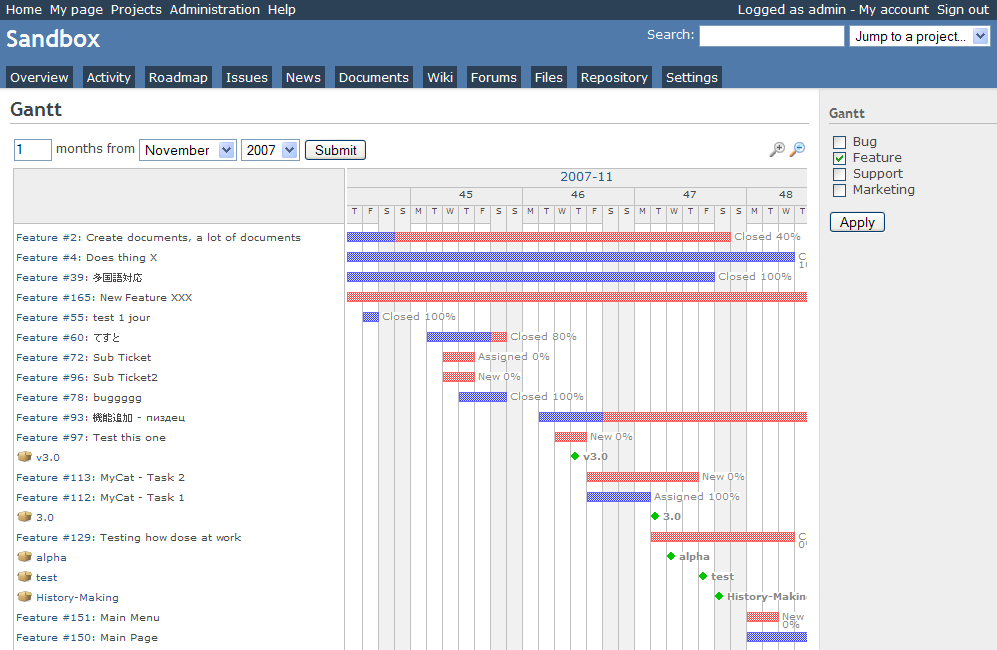
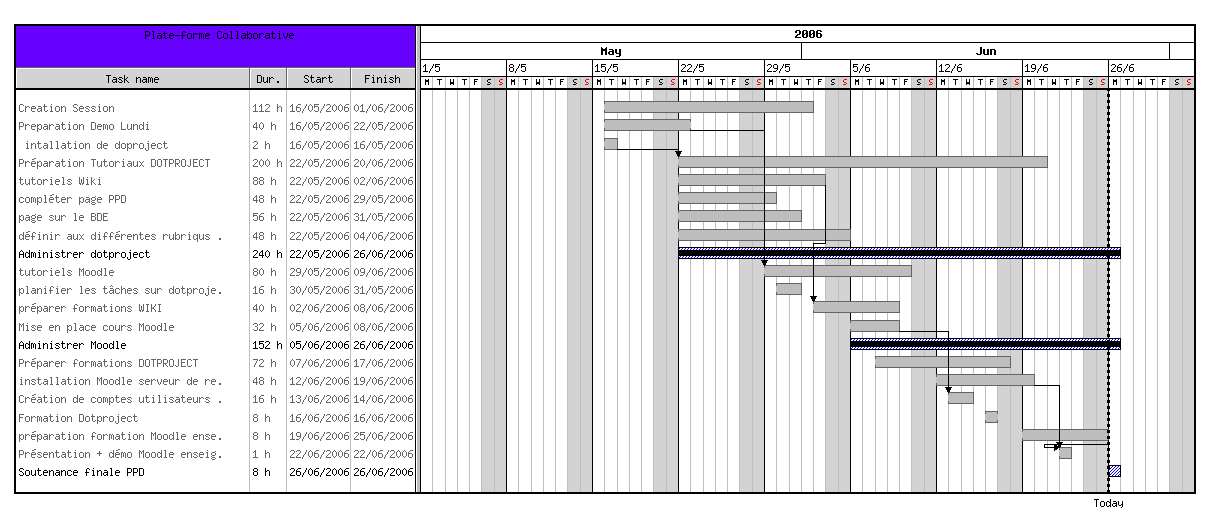
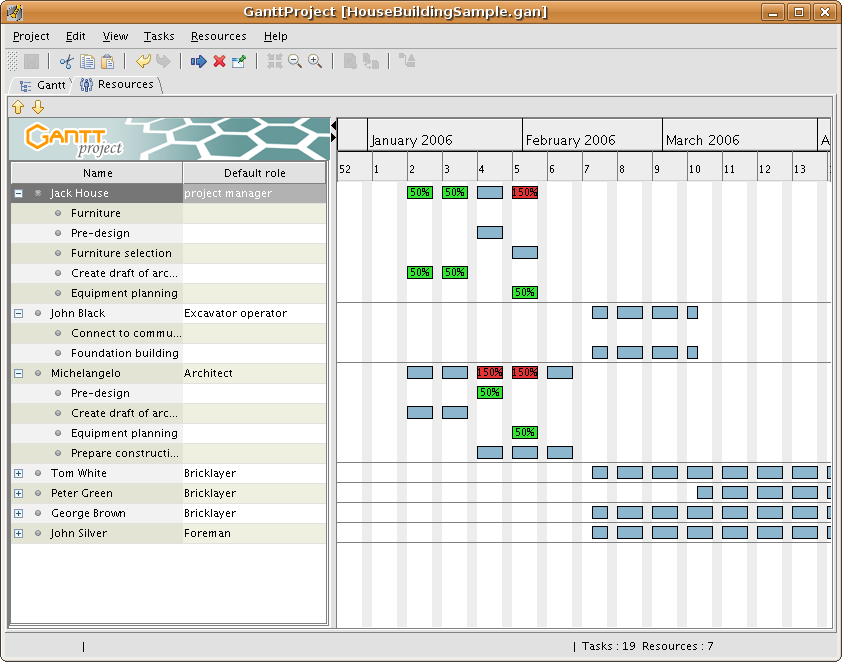 GANTTProject Chart
 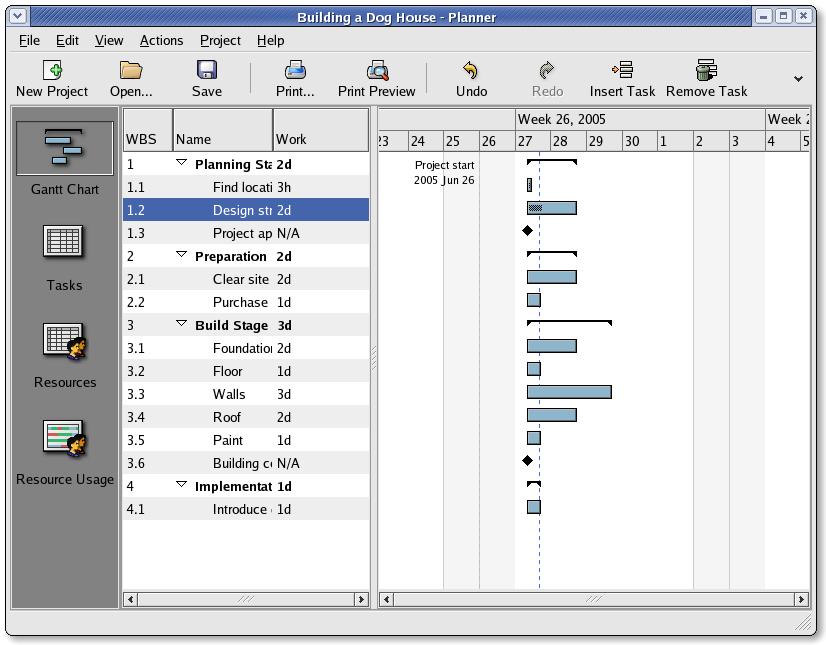 Planner GANTT Chone Chart
 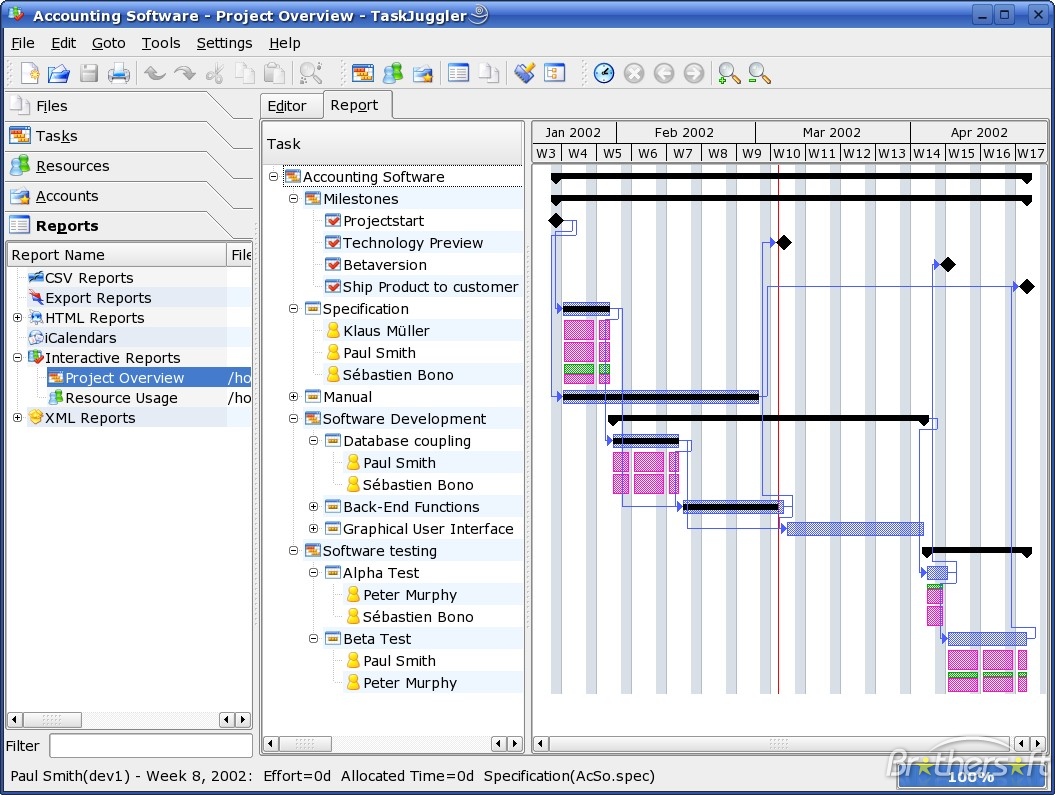 Task Juggler